Category: Lenses

Petzval designs, soft-focus, pictorialist lenses… Whatever you wish for. Innovations from the middle of the 20th century and from the depths of the century before. Back then, glass was more glassy and brass was more brassy. Nobody cared about size or weight. Character and bokeh were what mattered, and there is plenty of both here. Leave your pixel-peeping obsession at home and prepare for the perfectly imperfect. These lenses don’t capture photographs. They paint them.

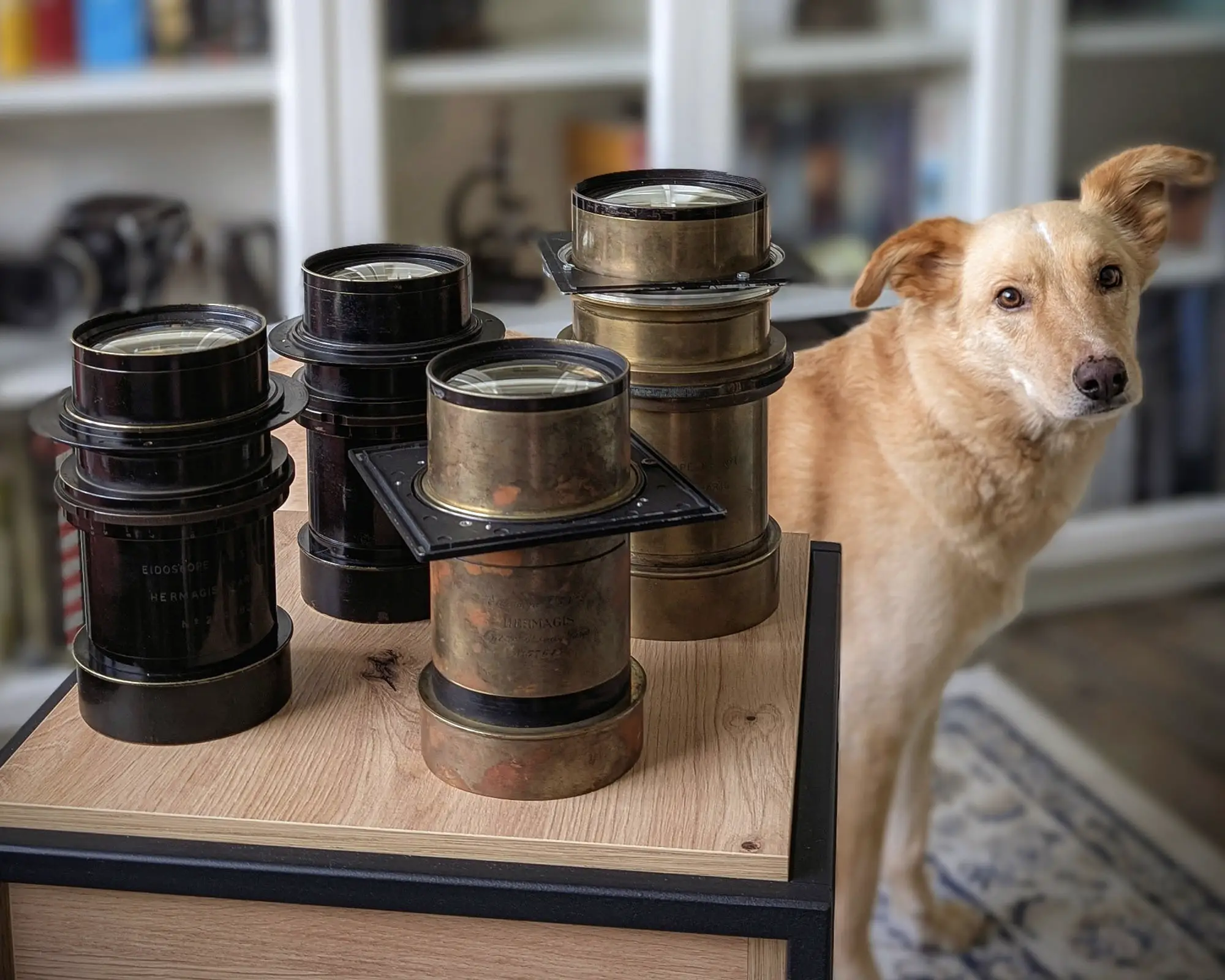
  • Eidoscope

    Eidoscope

    This is a transcription of a historical interview discovered among a bottle of red wine, a mouldy blue cheese and the legless skeleton of a frog during the restoration of the House of the French Crown. Uncolourised.

    Editorial Office: Welcome to the Lands of the Bohemian Crown!  It is our honour to host an emissary from the very bosom of photography here, in one of the centres of Central European artistic life.

    Eidoscope: At last, in the homeland of Drtikol, Novák and Sudek! The latter may still be dragging wooden shoes about, but I foresee a splendid future full of wooden cameras for him! *A beer lands upon the table.* Merci. And have you any wine?

    EO: Perhaps. But enough about us! Pray tell us something of your soft brass mission.

    E: Avec plaisir. I am the Hermagis Eidoscope. My journey began in Paris in the year 1903. They call me objectif à flou artistique, an artistic soft-focus lens. I was deliberately bred for impressionist photography and walk in the footsteps of such giants as Puyo and Pulligny or the Dallmeyer Bergheim. I would gladly recommend a fantastique article about soft-focus photography by Negativ na cestách, but alas, it shall not be written for more than a century yet.

    EO: You claim to be an artistic lens. Is that not merely an elegant way of excusing incompetence and passing off even the least successful result as creative intention?

    E: Anyone with eyes and a diaphragm ring may achieve sharp focus. With ordinary optics, the photographer sees precisely what he is doing, and should a photograph fail, the cause is usually easy enough to identify. With pictorialist lenses, matters are more complicated, for their peculiar character is greatly influenced by circumstance. The outcome is less predictable, and the boundary between a compelling artistic effect and a failed photograph is exceedingly thin. Despite the widespread belief that they merely facilitate the production of purposeless artiness, creating a truly fine pictorialist image is often more demanding than making a technically flawless sharp photograph.

    Without experience, their nature is difficult to divine, and when the uncooperative laws of physics intrude, perhaps in the form of chemical focus, it becomes evident that a convincing result requires considerable mastery of the entire process. One must see the result beforehand, for one shall not perceive it with one's eyes.

    EO: Then your soft disposition is founded upon error and chance?

    E: Upon error, yes, though it is no simple matter to determine what truly constitutes a defect. I prefer the term controlled illusion. Let exactitude and precision be left to accountants and engineers; the artist ought to court impression. And that impression I hold firmly in hand. Not for nothing does my name derive from the Greek words εἶδος (eidos—form, appearance) and σκοπέω (skopeō—to observe, to contemplate). In other words: perceive the whole, place form above fact, capture the essence. I shall attend to the embodiment of the idea. How much chance and unpredictability may contribute is, in the end, up to you.

    EO: Greek may have erected the pillars of science, but is that supposed to persuade the customer to purchase your optical cabaret instead of the precise scalpels of modern optics?

    E: Permit me a small prophecy. Alongside the great city, I glimpse a future in which flawlessness becomes the norm and everything is suitably magnificent, beautiful and sharp. Whether we wish it or not, a certain lifelessness accompanies it, followed perhaps by boredom, emptiness, and weariness. Man shall reach the heights only to desire a voluntary descent. Alarm at what we are capable of will drive us back toward the familiar past. After all, what you cherish most in those dear to you is not perfection, but their faults and little sins, their individuality and peculiarities; those very things that make them who they are. Defects are mankind's most beautiful privilege. Why should the same not apply to a lens?

    EO:  Please tell us more about the technical details.

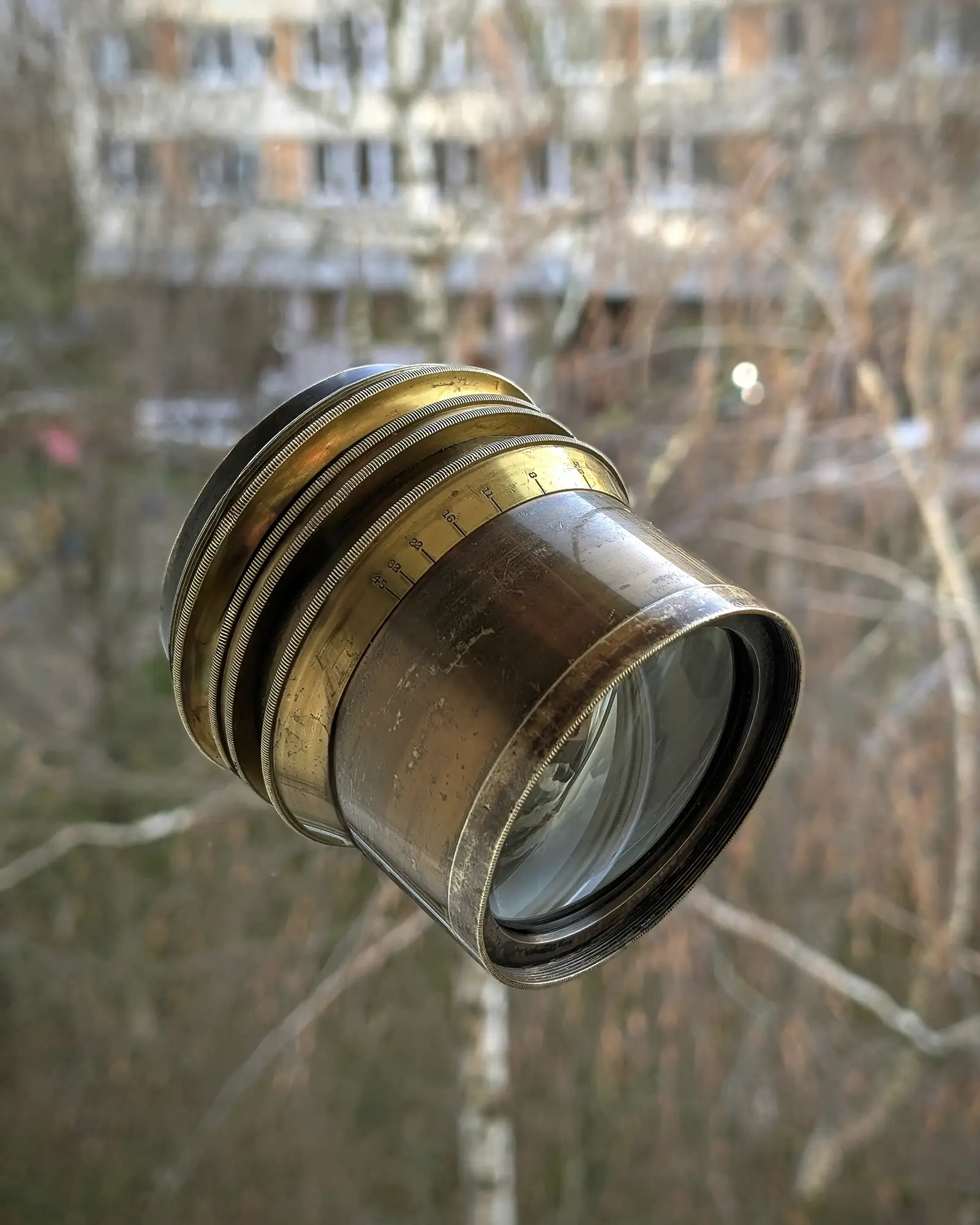
    E:  I may be found in many focal lengths and variations. From those intended for carte de visite, through half-plate and full-plate sizes, all the way to mammoth formats, where our largest specimen serves: the No. 0, 635mm f/5. Few shall ever make use of it, and I suspect you will not encounter one with any ease. My earliest selves may be recognised by their golden brass and waterhouse slots. In time, an iris diaphragm and perhaps an elegant blackened finish are also planned. But who can say? Perhaps, in some distant future, we Hermagis shall be taken over by the Société d'Optique et de Mécanique de Haute Précision Berthiot and converted to blackened aluminium. The advantage of lightness over brass is obvious enough, yet the soul shall lose some of its lustre. Beautiful things are often heavy.

    EO: How do you distinguish yourself from other artistic lenses? Why should one choose the Eidoscope in particular?

    E: There is both a technical and an artistic aspect. Let us first satisfy those of a technical disposition. Compared with my predecessors, I excel in speed—an aperture of f5 is a value worthy of the modern age. Certainly, Mʳ Petzval remains unmatched, yet the price of his virtues was collected elsewhere.

    My construction employs a pair of achromatic doublets which restrain chromatic aberration and undesirable colour fringing. At the same time, however, I leave ample room for spherical aberration to reveal its strengths. At full aperture, these qualities are most pronounced, while stopping down gradually diminishes their influence and renders the image sharp and precise. Furthermore, both the front and rear groups may be used independently thanks to the symmetrical Rapid Rectilinear design, granting the photographer several distinct configurations with differing focal lengths and rendering characteristics. It is therefore no exaggeration to say that within a single brass barrel I conceal several lenses, each with its own manner of expression for whatever need may arise.

    We have also innovated the aperture scale. Instead of today's confusion of competing systems, we have adopted our own approach and seek to bring order to the matter. Following the maximum aperture marked f5 come values such as 6, 7, 10, 14 and 20, corresponding to the actual aperture values and requiring no calculation. For in the Eidoscope, the diaphragm serves not merely to regulate light and depth of field, but above all to control the intensity and character of the artistic effect. This système permits a far finer degree of control, transforming the experienced photographer into a conductor commanding an entire orchestra. I am quite certain this innovation shall find favour.

    EO: Novel and progressive indeed! It remains only to win over the artists.

    E:  My true strength lies not in technical design, but in the manner in which I transform the photographic scene and unite precision with intention. I sketch an image that retains its descriptive character whilst remaining mysterious and fleeting. Bright passages are soothed by a characteristic shimmer and transitions between light and shadow assume an allegorical, almost otherworldly quality. The result is a unique harmony of sharp lines, soft radiance and atmosphere. I am nature's pencil. What is drawn, however, depends entirely upon your imagination.

    EO: Then once again the most important instrument is the creator himself. Let us hope that the future grants success to the Eidoscope. Time, after all, remains the finest sieve of quality. What shall your final words be?

    E:  L'Eidoscope ne photographie pas, il dessine!—Eidoscope doesn't take images; it draws them!

    EO: *A carafe of the finest wine appears upon the table.*  May the world continue to paint, whether with brush or glass.

  • Bausch & Lomb Portrait Unar

    Bausch & Lomb Portrait Unar

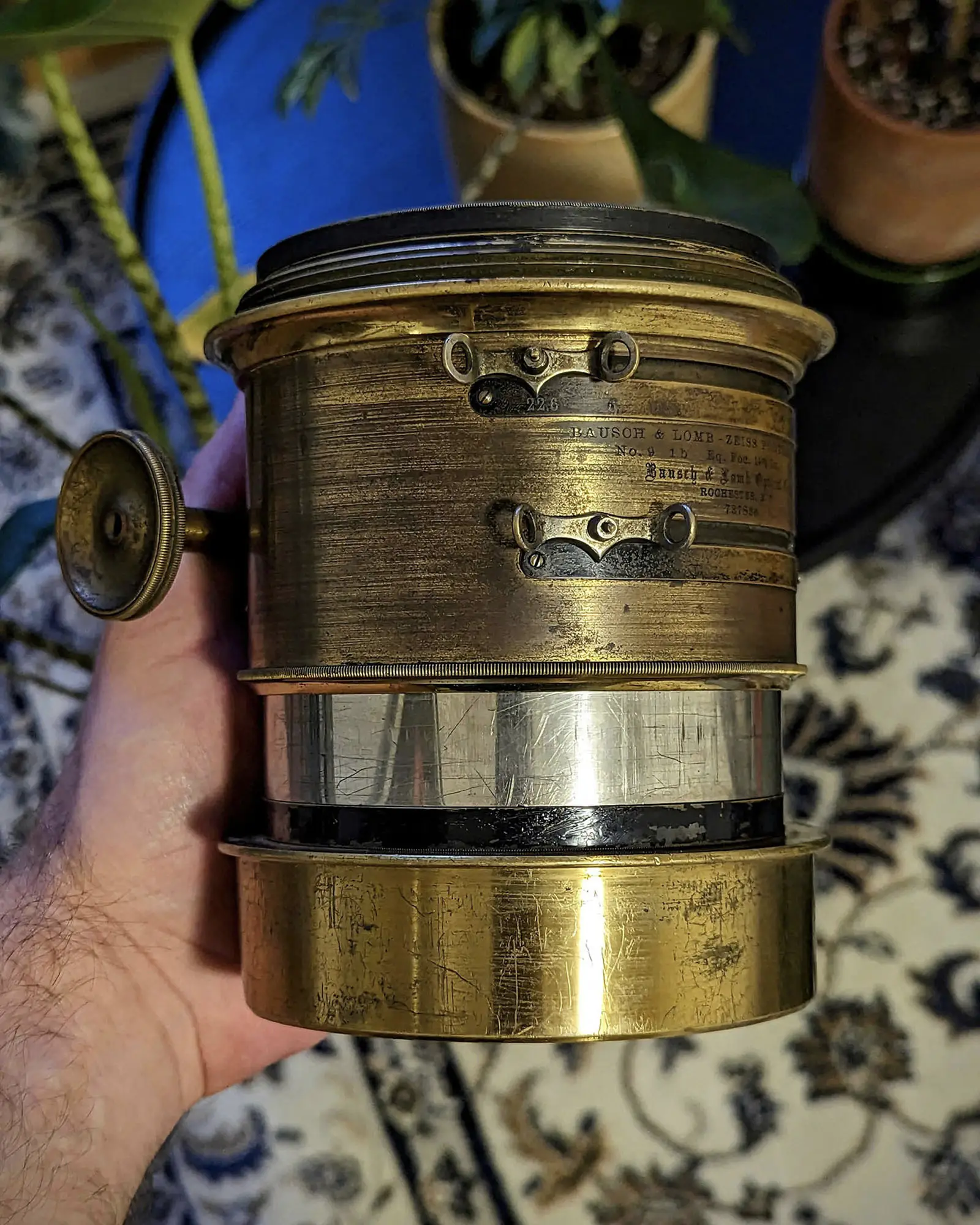
    So one day over at Bausch & Lomb, they sat down and decided it was about time to give TTH's portrait triplets a good kick in the nuts. Those lenses had been successfully annoying the competition since 1898.

    • Behind the cryptic acronym TTH hides none other than the illustrious English firm Taylor, Taylor & Hobson. Their immortal fame came mainly from the Cooke portrait series, famous for offering adjustable soft focus. Every Tom, Dick and Harriet knew their Series II (f3.5–f4.5) and VI (f5.6), with the trademark soft-focus control that looked like brass knuckle dusters. Hence the informal and well-established nickname: Knuckler. These were among the first anastigmats with variable diffusion, and for the next fifty years they became an integral part of portrait photography. They also caused every damn lens maker on the planet to desperately want their own Knuckler.


    B&L weren't about to miss that party. Together with their German BFF Zeiss, they rolled up their sleeves and in 1904 hammered out the Unar. But hold your horses. The story is more twisted than that.

    The Unar design was originally calculated at Zeiss by Dr. Rudolph in 1899. It was a four-element anastigmat with no cemented groups, basically one lens more than your neighbor's Triplet. Unfortunately, the concept aged about as gracefully as mayonnaise in the sun and quickly fell behind the demands of its time. The original Unar (before it got the Portrait label and soft-focus option) convulsed in its death throes for a bit, until Zeiss buried it in 1902 with the brand-new Tessar. More precisely, Dr. Rudolph striked again.

    • Tessar (from Greek τέσσερα, téssera = four) also has four elements, but the last two are cemented into a doublet. You don't need a PhD to see the family resemblance: one evolved from the other. Tessar simply turned out to be the more gifted child and Zeiss loved it more. Unar lost. Tessar became one of the cornerstones of photographic optics.

    • And by the way, all those companies are still alive and kicking. Bausch & Lomb now makes contact lenses (still lenses! Just for eyes). Taylor Hobson makes metrology instruments, Cooke Optics spun off and builds high-end lenses (their shared history is a soap opera for another time - they're still flirting with soft-focus, see the Cooke PS645), and Zeiss is still busy sticking its fingers into everything.

    So what about 1904? Well, picture this: just like Gandalf the Grey fought the Tessar in the mines of Moria, Unar the Brass was out there on the optical Pellenor Fields battling Balrog. Or something like that. Point is, both Unar and Gandalf fell, only to come back stronger than ever - Gandalf the White and Portrait Unar.

    • Behind Unar's phoenix-like resurrection was Zeiss, being just a little bit cheeky. First came Unar. They tweaked it a bit, bam, Tessar was born. But hey, why not squeeze a few more marketing drops out of the soft-focus craze? So they dusted off the Unar design, slapped on a diffuser, gave it a bit of a makeover and voilà - Portrait Unar was born. It wasn't some groundbreaking new design; it was basically the old one with its flaws repackaged as "features." Classic marketing, already working overtime back then.

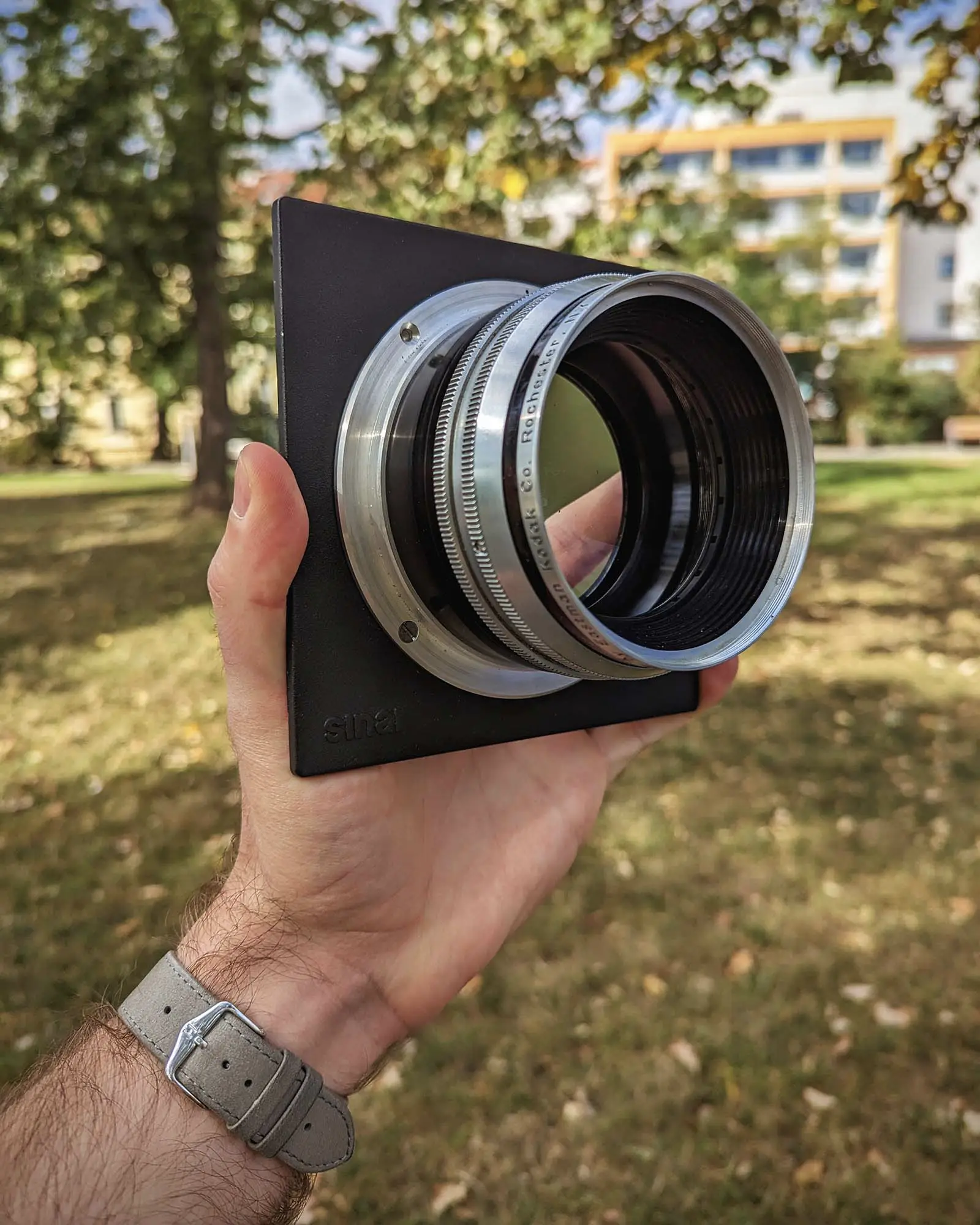
    Now for the truly weird part: the construction. This thing has an aperture mechanism with blades, a rack-and-pinion focusing system and a separate soft-focus slider. The main barrel is made of several nested inner tubes like some optical Matryoshka doll, all connected together. Connected precisely together by tiny screws roughly the size of the close buttons on internet ads. Move one of those tubes by a yoktometer and the whole thing is fucked. And as if reassembling it weren't masochistic enough, you've also got to calibrate it perfectly so the aperture scale doesn't start halfway through. Trial/error. GLHF.

    You can't really access most of it properly, and unless you know exactly what you're doing, you might as well get comfy because it's going to be a long night. The number of possible assembly combinations is similar to Rubik's Cube and only one of them actually works. I found that out the hard way. After hours of intense cursing I managed to put it back together and even had a screw left over. I decided it was a factory-installed self-destruct feature.

    • The moving tubes inside the barrel come with a little surprise: friction. Unars are notoriously stiff when you move the rack-and-pinion or the other sliders. A lot of people assume it just needs "a bit of grease," so they start slathering it like they're basting a Christmas turkey. But the culprit is simply friction. Lots of tubes + lots of surface area = lots of friction. All you can really do is clean it and accept that it'll never glide like a Jamaican bobsled team.

    • Actually, there are two nasty surprises. The second is the infamously disgraced aperture. The blades were made from cellulose, which was brittle and not exactly known for its longevity. It didn't take long for them to simply rot away. Finito. And the ones that didn't crumble on their own usually met their doom at the hands of some enthusiastic DIY person, who under the noble pretense of cleaning (see above) dissolved them with wide-eyed horror. That's why the vast majority of Unars have no diaphragm blades left, and all you can do is spin the aperture ring and pretend. But honestly, who was going to stop the lens down anyway? They were basically just forcing you to shoot wide open and bathe in all that bokeh and character. Aha!

    • To be fair, Bausch & Lomb were experts at this not just with the Unar. Their Petzvals and other models from the same period suffered from similar issues, though less dramatically. If you ever find one with an intact aperture, there are only two explanations: you just won the lottery and you'd better not even look at that diaphragm the wrong way, or It's a modern restoration. Which was expensive. Extra expensive². So don't mess with it either.

    To give credit where it's due, everything else about the lens is top-notch. This was B&L's showpiece, meant to go head-to-head with TTH, and it shows. The build quality is superb and both the aperture and soft-focus selectors move with a crisp little whoosh that's weirdly satisfying - like the signature "puff" of air you get on a Knuckler when you twist it. The aperture ring sits closer to the flange, while the diffuser scale, marked 1–4, is placed before the diaphragm. One is the sharpest setting, four is the dreamiest mess.

    • And here's a fun detail for the 0.0042‰ of humanity who might care: the lens screws right onto a Hermagis Eidoscope No.1 flange. So if you're missing a flange and, by some cosmic coincidence, you've got a No.1 Eido lying around, congratulations! Jackpot!

    The most striking foreign feature, though, is the set of control rods. Both selectors have unmistakable sliders with holes on each side. They were meant for attaching strings, so the photographer could adjust settings from behind the camera without stepping away from the ground glass. Genius in theory, but considering the aforementioned friction, you'd need Arnold Schwarzenegger to actually pull it off. Still, it looks amazing on the diagrams.

    • The only other lenses with the same slider system were the Portrait Series A f4, B&L's Petzvals, and the high-speed Series B f2.2. As far as I know, that's it. You won't find this oddball setup anywhere else.

    • The Portrait Unar series came in four sizes: 10", 12", 14¾", and 18", all at f4.5. The biggest one shows up only sporadically in official catalogues. Apart from the version discussed here, there was also a later redesign that ditched the perforated sliders and moved toward the more modern visual language of lenses like the Plastigmat with double-hatched control rings.

    In the attached period records, you might notice some odd code names that look like they belong in a spelling alphabet: Xiar, Ximar, Xilet and so on. No, it's not some Romanian incantation, but telegraphic codes, a standard part of the industry back then.

    At the turn of the 19th and 20th centuries, if a gentleman wanted to order a lens from across the world, he'd send a telegram. And since telegraph companies charged by the letter or word, manufacturers used short, unambiguous codes instead of spelling out "Bausch & Lomb - Zeiss Portrait Unar, Series 1b, 380mm f4.5." Just send Ximat and everyone knew what you meant. Catalogues included these code tables to make the ordering idiot-proof. Some companies (Zeiss, Voigtländer, Ross, etc.) even registered entire proprietary telegraphic dictionaries to keep their orders clear and foolproof. Voigtländer in particular loved this stuff and their catalogues are basically telegraph nerd heaven.

    As for the actual image rendering, Portrait Unar behaves pretty much like other anastigmats of its league. At the lowest soft-focus setting and wide open, the lens gives you pleasantly sharp, portrait-friendly images with just the right amount of contrast. Stop down even a homeopathic amount and sharpness skyrockets. Thanks to its flat-field design, it renders groups beautifully too.

    • Quick recap: flat-field lenses bend perspective less, so the image stays sharp and well-defined across the entire frame. This makes them excellent for group portraits and essential for technical work.

    • Curved-field lenses, on the other hand, tend to prioritize the center, with sharpness dropping off dramatically toward the edges. Petzvals and old meniscus optics behave like this. It's perfect for characterful portraits or artistic shots where accurate reproduction of reality isn't exactly a priority.

    If you want to crank up the soft-focus effect, you'd better have a trained eye. The diffusion is on the subtle, elegant side. Even at the max setting, don't expect some mushy glow. And that's not a flaw. For this class of lens, that kind of restrained, delicate diffusion is exactly what you want - it smooths out skin and softens wrinkles without turning people into blurry marshmallows.

    But don't throw your Unar in the bin just yet, my squishy pictorialist enthusiasts. Here's a little underground trick. If you unscrew the rear cell and use it on its own, you get a surprisingly hardcore soft lens with a rendering reminiscent of a <a href="https://negativnacestach.cz/en/kodak-portrait/ Adapting it isn't exactly a walk in the park, since the flange thread sits inconveniently close to the rear group, but with a bit of DIY skill (of which, tragically, I have next to none) you can elevate the Unar to a whole new level. Sure, you'll lose the diaphragm, soft-focus slider and lens hood, but you'll end up with something like an Oscar Zwierzina Plasticca or a Kronar/Kronarette. Basically, you'll start painting. As you can see, the Unar is a gloriously non-boring piece of glass, blending the familiar with the unexpected, the earthy with the dreamlike. So next time someone hits you with the usual barrage of questions - "Are you shooting portraits? Landscapes? Nudes? Will it be sharp, natural, soft, pictorialist? Stopped down a lot, a little, somewhere in between?" - your answer is simple: YES.

  • Dallmeyer 3B

    Dallmeyer 3B

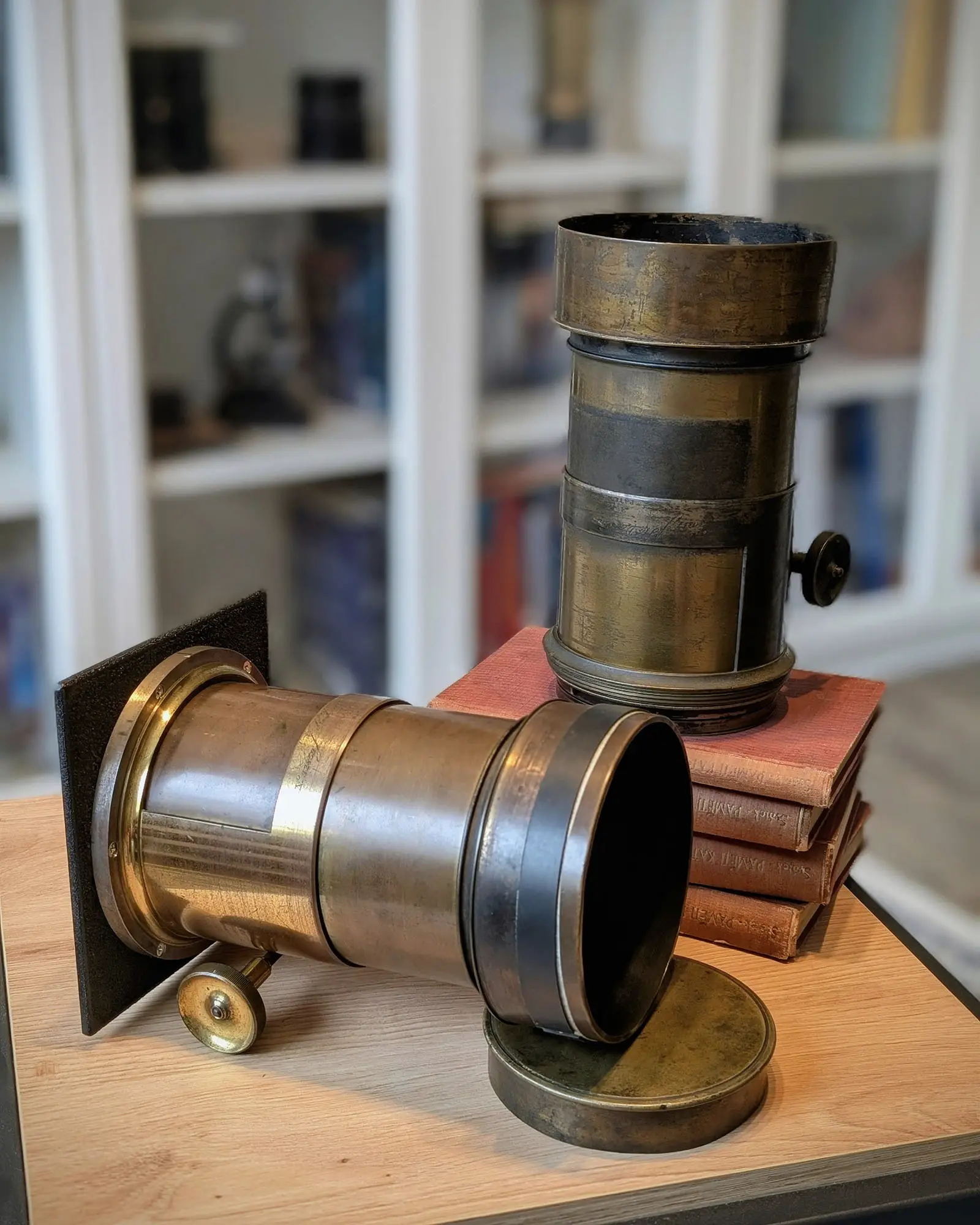
    In the previous article, I pondered and mused, among other things, about how only a few of my portrait lenses can currently challenge the Hermagis Portrait and the Fast Worker in the ring without immediately throwing in the towel. On paper, the Dallmeyer 3B 290mm f3.9 seemed like an evenly matched opponent—so how did it turn out? Did the Dallmeyer Series B confirm its legendary status and join the ranks of Hermagis and Hugo Meyer? Or were the tales exaggerated and instead of a triad of equals, only two champions continue to jostle on the pedestal? Whoa not so fast! Let's take a scenic detour. Through London, Florence and small Czech town called Kostelec nad Černými lesy. 

    As hinted in the preface above, I was gradually blessed with not one, but two specimens of differing age. One was sold on 25 October 1873 to Sig. Broschi in Italy; the other was taken over in May 1883 by the mysterious Mr. Alman (that is, if I am deciphering that damn handwriting correctly). I have found nothing about Sir Alman. I even rummaged through alternative spellings of the surname, in case someone along the way had been creatively inaccurate—but either time swallowed the gentleman's reputation whole, or he may have been a dealer supplying other photographers, a courier, a misrecorded name, or… The trail went cold.

    Don Broschi is more promising No photographer or studio of that name appears to have operated in the given period, or else the sieve of history proved merciless.

    However, misspellings were common—often transcribed by ear, all the more so across languages—and illegible entries were hardly a rarity.

    And now, into the whirlpool of speculation. Broschi could very well have been a mangled Brogi—the Florentine capo di fotografia Giacomo Brogi, who, together with his son Carlo, ran the firm Edizioni Brogi Firenze, active until 1950. The year 1873 would fall neatly into Giacomo's most prolific artistic period. And as Horst Fuchs would say: "That's not all!" The company established studios throughout Italy and, alongside its massive photographic output, dealt in the purchase, resale, and distribution of cameras, lenses, and chemicals of various brands and national origins. Brogi also regularly participated in international photographic exhibitions, such as the Esposizione Nazionale di Milano in 1881 or the 1873 Vienna World's Fair, where Dallmeyer also exhibited. It's not therefore absurd to imagine him acquiring this lens there and then—or perhaps returning home from Vienna flushed with excitement and immediately placing an order via the internet telegraph. The date of sale (25 October) aligns suspiciously well with the exhibition's duration (1 May to 31 October). This entire theory may rest on water rather than stone—but the clues fit together rather nicely. The lens itself shows clear signs of having been thoroughly mounted and seriously worked. So perhaps I do, in fact, own Giacomo Brogi's lens!

    • Not that it dropped from the sky—I had to roll up my sleeves and dive headfirst into the dusty annals of the Dallmeyer factory. If you're willing to poke around their web archive, you can actually dig out a surprising amount of info about the who, what, when, where, and how. Sure, the lists are far from complete and the site sometimes runs like it had a stroke, but let's be grateful it exists at all. That's not always the case. And I don't just mean someone bothered to compile the archives - first they had to bloody survive. Through wars, floods, and generations of people not giving a fuck. And to even have a shot at surviving, someone had to make them in the first place. And no, it doesn't apply to everyone—and yes, I'm looking at you, Swiss Suter.

    Now, allow me my blissfully naive fantasy: that for all those decades, this brass beauties were out there relentlessly immortalizing corseted maidens and top-hatted gentlemen. Think of the faces they saw, the stories they witnessed, the places they traveled—if only these golden tubes could talk. But let's be honest: they probably spent the last God-knows-how-many years collecting dust in a banana box down in some musty basement, nestled between a dead rat and last decade's Christmas decorations. And then one day, during spring cleaning, someone thought, "Hey, maybe I can flog this." Still—I prefer the corsets and cylinder hats version. Don't ruin it for me.

    So where did the B Series come from?

    London, of course. Before starting his own business, John Henry Dallmeyer worked under Andrew Ross (and, as a bonus, married off his daughter). Ross was one of the early trailblazers in lens-making, crafting optics as early as 1840. Meaning he was there while the View from the Window at Le Gras was still drying. And the design of Dallmeyer's B Series is heavily inspired by A. Ross's original portrait line. What you learn from your master, you eventually use to build your own empire. Or, you know, copy with flair.

    So, why all the fuss about this lens?

    Because it's a bloody masterpiece of craftsmanship. It's optically brilliant, it's got a variable soft-focus mechanism (something Ross didn't bother with) and—most importantly—it's got an aperture of f3. Sure, that doesn't exactly make people going mad nowadays. Every flea market is littered with Chinese crap boasting f0.95 and similar marketing-fueled specs. But here's the catch. No—scratch that. Here's the whopper.

    It's the image circle. The coverage. The goddamn photographic battlefield. Most modern lenses barely manage to cover an APS-C sensor without breaking into a sweat. Maybe a full-frame if they're feeling badass (which, for the clueless, is a teeny-tiny 24x36mm, originally derived from one frame of 135mm film. Ha, bet you've always wondered where that weird number actually came from, right?). But this Dallmeyer? This bad boy covers damn near an A4 sheet of paper.

    I won't bore you with too many technical details, but here's the kicker: the larger the format, the shallower the depth of field at the same aperture. Shooting at f3 on 135mm film? Meh. You take a portrait, and the whole person's acceptably sharp. Big whoop. But shoot at f3 on something like 8x10"? Oh boy. That's when the magic happens. You nail the eyes, whisper a prayer to Saint Scheimpflug, something twitches by a millimeter and bam—suddenly you're focused on a nostril or the edge of a single damn hair. Depth of field? Razor-thin. Blink and you've missed it.

    This kind of thing raises the bar for both the person behind the camera and the poor soul in front of it. The slightest mistake? Enjoy your blurry mess. But when you nail it—really nail it—the depth of field and 3D effect look like they've been beamed in from another dimension. Want to compare it to modern tech? You'd need to build a lens for full-frame that shoots at f/0.4. Let me say that again: f-zero-point-four. And guess what? That's physically not gonna happen. And if by some miracle you did pull it off, it'd be a smudgy puddle of optical diarrhea riddled with every optical failures in our solar system.

    • Yes, this is the simplified version. For the math fetishists and lens autists out there, feel free to dive into terms like "equivalent aperture," "image circle," "depth of field," or "crop factor." 
    • But the aperture as fast as that one didn't just serve to please the eye—it also made life easier in the studios of the past. See, back in the day, photographic materials had the sensitivity of a blind mole. Daguerreotypes, Collodion process, you name it—exposures took ages. So faster lenses like this one weren't just sexy, they were revolutionary. They chopped exposure times from dozens of seconds down to fractions of a second. Total game-changer.

    There were countless variations, in-between models and Frankenstein hybrids, but let's stick to the two most important iterations. That said, regardless of version, this thing is rare as hen's teeth. Even though quite a few were made, it's still a unicorn. If you've got one—keep an eye on that.

    • The earliest versions were from brass, equipped with a rack & pinion focusing mechanism and good old Waterhouse stops (occasionally and very rarely also with iris diaphragm). The soft-focus mechanism was tucked away in the rear and you adjusted it by rotating the rear element. There were notches and an indicator, and the more you unscrewed, the dreamier and more melted the image became. You could go up to about five full rotations. Downside? You had to remove the lens from the camera to adjust it.
    • The second version ditched the rack movement and made SF adjustment way less awkward—it moved the control up front. No more brassy juggling. Still golden, still dishy, but now with a standard aperture made of blades controlled by a lever.

    Alright, time to bite into that half-eaten apple—how does it actually shoot? Well I hate test shots. Checkered paper, bricks, still life with whatever I found in the room—no thanks. So I decided to skip the foreplay and jump straight into the deep end. Trial by fire. Just take it out into the wild and see what happens. And what better place to do that than the fantastic annual event Umění nás spojuje a.k.a. Art Connects Us in Kostelec nad Černými lesy? (Maybe I'll see you there next time!) There I managed to hunt down a few willing human specimens and put this antique colossus through its paces.

    And it shoots… breathtakingly. Sure, I lucked out with unusually disciplined models sporting near-superhuman self-control—no one was twisting, no headrests or chloroform required. Even I didn't budge an inch with my heavy-ass Sinar S 8x10". The results are laying around here (I didn't even stopped down the aperture or increased the softness this time, so these are fully open and razor-sharp to the max), and I'm pretty sure you'll at least agree on one thing: there's a LOT of plasticity, sharpness, and... yeah, I'll say it again—character. So, Hermagis, Hugo Meyer, or Dallmeyer? Well, what's your verdict?

  • Hermagis Portrait

    Hermagis Portrait

    What makes a portrait lens truly great? What should we highlight, what combination of features should it have? Let's subtly ignore weight and size and cut straight to the essentials— so first and foremost:

    • Aperture - because time is a cruel mistress: for alternative processes with low sensitivity, speed is everything. A fast lens means you won't be stuck with exposure times measured in seconds (or worse, tens of seconds), sparing your subject from playing a torturous game of "Statues" or being strapped into one of those Victorian-era head braces that look like they belong in a medieval torture exhibit. Oh, and of course—a wider aperture means shallower depth of field and creamier bokeh ..
    • Bokeh - beauty is in the blur: better bokeh is subjective, and no, faster doesn't always mean smoother. But let's be honest—it often does.
    • Depth of Field - the double-edged sword: shallow DoF is gorgeous. It sculpts the image, adds depth and draws the eye. But the shallower it gets the harder it is to nail focus. If you're shooting something static, the only thing standing between you and a tack-sharp image is your own (in)competence. But people? Even the most disciplined model will shift—especially if you don't use the chloroform. And when you're working at f3 or faster, like with a Schnellarbeiter, we're talking about millimeters of focus. One small twitch and—congrats!—you've just perfectly focused on their nose instead of their eye.
    • Speaking of chloroform, it wasn't just a joke—it was actually used in the early days of photography to calm down infants and small children during long exposures. Back then, exposure times were long and patience—both of mothers and photographers—was short. But hey, in small doses, it can't be that bad, right? Like rum.

    A little off-topic: the game known as "Statues" or "Green light, red light" is known in the Czech Republic as "Cukr káva limonáda, čaj rum bum", which could be translated as "Sugar coffee lemonade, tea rum boom." The whole thing rhymes in Czech and speeds up as the game progresses, so it is also a verbal pun. And Czech children obviously like rum and explosives. If you don't have a sedatives, the light is blinding, or you're trying to photograph a bunch of fidgety humans, an aperture comes in handy. Whether it's an old washer-style one, a Waterhouse slot system or a classic iris diaphragm—something's bound to be useful. And let's be real, while a bladed iris is the most complicated, most fragile and slightly eats up light, it's also the most user-friendly.

    • Because unlike metal stops, you won't lose it! Well, at least not as easily. Those things disappear faster than odd socks—one moment they're there and the next they've joined the Bermuda Triangle of household objects.

    What else? Contrast, sharpness, edge fall-off—all very subjective. But I think we can all agree that a lens must have character—whatever the hell that means. Does it swirl the background into a fever dream and paint bokeh like little donuts, hexagons, or twelve-sided dice? Does it fail to cover the full image, blessing you with vignetting darker than a Congolese plantation worker's hands? Who cares! The point is, it's got that elusive, unexplainable something.

    • If you're hunting for that something, Petzval lenses are your best bet. And even among those, some stand out. When it comes to portraits, you can't ignore the Dallmeyer A and B series or the unmistakable Darlot/Jamin Cone Centralisateur. I REALLY WANT THAT ONE. A already have, heh.

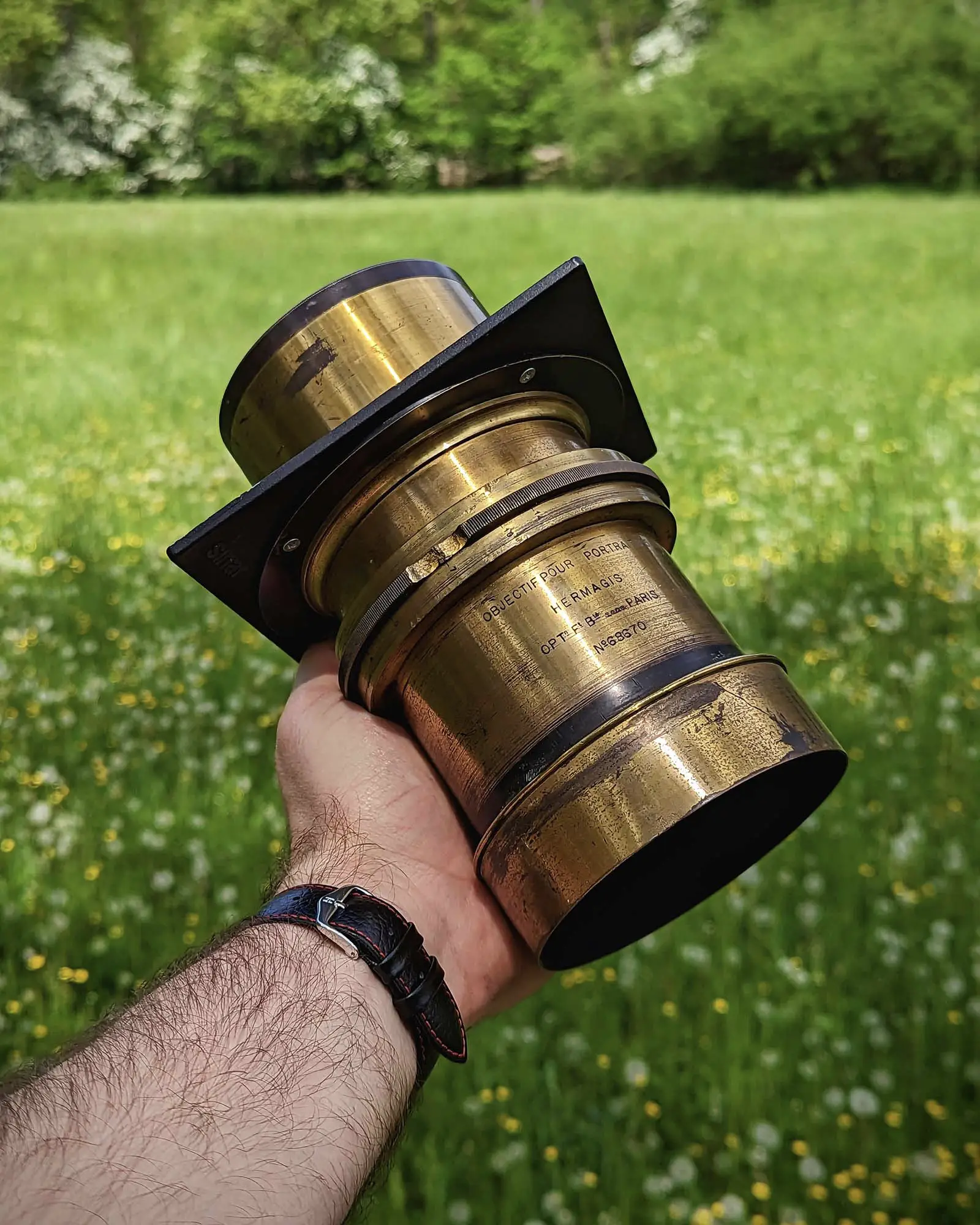
    No more fluff, time to shock the reader—the Hermagis Portrait 310mm f3.9 lens checks every damn box for a flawless portrait lens! With an aperture around f3.9, it's hella fast, but not quite as razor-thin in DoF as f3 and below. Below f3?! Yes, we're talking about Walzl (or variations like Waibl or Wcaibl), Ross, Dallmeyer C etc.

    • Sure, a bladed iris slightly dims the light transmission, but let's be real—lens manufacturers themselves had such creative math and "flexible" constants that their stated specs often drifted more than any mechanical loss from the iris. A tenth of a stop here, a tenth there—whatever. Your exposure meter (and you) will screw it up worse anyway.

    Dreamy bokeh? Check. Contrast, sharpness, delicious vignetting? Check, check, check. An iris diaphragm? Damn right. And that indefinable magic? Look around—it's oozing character from every surface! And, if I may say so myself, I managed most of these shots without resorting to chloroform. The No.5 focal length is just right—pretty much perfect for head-and-shoulder portraits (obviously for the best format in the world, 8x10"). Wide open at infinity, the vignetting is intense, but that's par for the course with similar lenses like Dallmeyer 290mm f3, Hugo-Meyer 310mm f3, Darlot 300mm f4, Voigtländer f3.3, etc.

    I've had both the modern version and an older type with rack & pinion focusing, waterhouse stops and a completely different chassis design—right down to the font and its layout. Optically, though? Identical. And both painted beautifully. Sitting on my shelf, waiting for sunny days and willing models, is the legendary Dallmeyer 3B—one of the few lenses actually capable of stepping into the ring and going toe-to-toe with my beloved Hermagis. So, I'll test it, I'll see it, and at some point, I'll write about it. Already wrote! But for now, let's circle back to the opening question—the one that's ultimately pointless and irrelevant: Which portrait lens is perfect? You already know the answer. None of them. And all of them. Each is beautifully flawed, uniquely imperfect. Because perfection, my friend, exists only in imperfection. Čaj rum bum.

  • Crown Anastigmat

    Crown Anastigmat

    It's almost become a mantra to kick off my articles with lines like, "The only lens in the universe", "A ridiculously rare contraption", or "Rarer than hen's teeth." What can I say? I wallow in the extraordinary, feeding the illusion of my own uniqueness. Enough excuses, though - let's dive into today's lens. A piece so outrageously rare that even a careless lover of New Year's firecrackers could count them on one hand. Presenting the completely unknown soft-focus Crown Anastigmat Series I 300mm f4.5.

    • Once upon a time there was a company called Crown Optical Co. Rochester N.Y. (not to be confused with Crown Optical Co. Ltd. of Japan!). They were based in Rochester, once the Mecca of American optics. It housed giants like Bausch & Lomb and Kodak, along with a myriad of smaller manufacturers. 
    • Crown fell into the category of small, short-lived companies. A. H. Hatmaker founded it in 1906 with his secretary A. E. May, only to have it swallowed by the U.S. government in 1917 and folded into the Naval Gun Factory. For two years they devoted themselves entirely to the war effort - and by 1919, Crown was gone.

    Out of the entire thirteen years of the factory's existence, a large part was devoted to the production of army binoculars and periscopes. Eleven, actually, because for the last two years NGF no longer produced even them. Almost nothing is known about the company, its portfolio, and especially the Series I line. There are no surviving serial-number records, so estimating production is a shot in the dark. Given the size of the business, its mayfly lifespan and the even shorter run of photographic optics, I'd wager only a few thousand lenses total. The entire Series I? Maybe a few hundred. This specific Series I 300mm f4.5? At best a few dozen, maybe not even that.

    Soft-focus lenses never were and never will be at the center of attention, nor the main production pillar of any company. Throughout history, they've been a niche curiosity - and in the version with adjustable internal movement (Universal Heliar, TTH Cooke, etc.), hellishly difficult to make. Just like in-house calibers or a tourbillon in watchmaking, or the Austrian Sacher, these are sophisticated solutions demanding extreme know-how. Which makes it all the more remarkable that such a tiny factory, with such a short lifespan and not even fully dedicated to lens production, managed to develop exactly this kind of piece. It's of course possible Crown rebranded the design and licensed it from another maker, but a) I doubt they had the money or a reason to do so, and b) I don't know of any other SF lens of these specs and looks. And I know them all!

    • The lens allows adjustment of the soft-focus effect via a separate ring, ranging from levels 1 to 4. Changing it shifts part of the optical system back and forth, slightly altering focal length while controlling diffraction and thus the softness of the image. This represents the pinnacle of optical engineering, achieved by only a few manufacturers, earning it a reputation as "nobility" among lenses. You can read about other methods of regulation and SF in general in my previous article.
    • It was also a hot novelty back then: the anastigmat. An optical scheme with very well-corrected spherical aberration, astigmatism, and coma. Designed in 1890 by Dr. Paul Rudolph, its first two decades were more of an experimental phase. Crown's achievement is therefore doubly impressive.

    So what about that promised resurrection? Here's the story: the lens arrived to me from faraway lands in a frightfully dilapidated state. The SF mechanism and aperture were fortunately relatively intact, but the most crucial part, the heart of the lens - the glass itself - was hopelessly separated. I did take some photos with it, and the results looked far better than one might expect from its outward appearance. Even so, it pained me to let something so rare suffer such a sad fate, so I began pondering what could be done.

    • In this context, separation refers to the breakdown of the cement layer that bonds the optical elements together. Manufacturing flaws, improper storage, a fall or who knows what else can trigger separation. It manifests in various ways, but the common symptoms are a loss of contrast, sharpness, and an increased susceptibility to stray light. The cure is singular: remove the old "glue" and re-cement the lens.
    • Back then, the glue was so-called Canadian balsam. This mixture of resin from the balsam fir (Pinus balsamea) and xylene in a 1:1 ratio creates a substance with a refractive index almost identical to quartz glass. Once cured with heat, this concoction becomes clear and bonds the optical elements together without negatively impacting image quality.
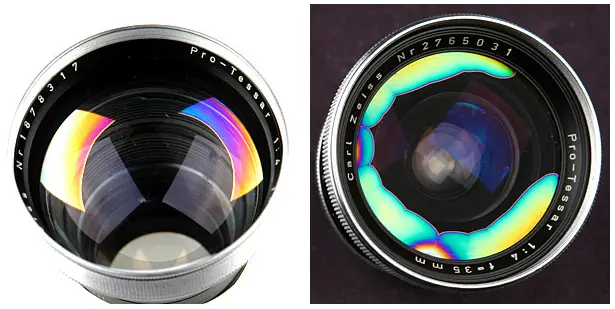
    • Separation usually starts at the edge and mostly stays there. It's often yellow to orange, with a cracked look, and in extreme cases it can cover most of the surface. With more modern lenses that feature coatings, separation often shows up as multi-colored rainbow effects that, while visually intriguing, are still undesirable. A special case are "flowers": tiny dust grains trapped during cementing, around which separation slowly spreads like petals. Since no air = no oxidation, these spots remain clear and are kind of pretty - but still a pain in the ass.

    The theory of re-cementing was familiar to me, but it's much easier said than done. Just getting your hands on Canada balsam isn't exactly a walk in the park (and playing around with xylene at home is even less so). On the internet you'll find plenty of guaranteed guides on removing old adhesive by gently baking the lens in an oven (where you'll also bake the new adhesive in place) or slowly heating it in a pot of water. What these guides often leave out, however, is that you're running a high risk of thermal shock and irreparable cracking of the fragile, old glass.

    • The whole concept of "cooking" lenses reminded me of the time I, blissfully unaware, stumbled across a surprisingly detailed online recipe for making homemade napalm. At least that one mentioned that boiling a pot of gasoline on your stovetop might be somewhat precarious - and might just blow up your house. And before you ask, no, I don't remember where I found that recipe. Probably somewhere in old family cookbook.

    And how do you ensure that the elements are reassembled exactly as they were before? Easy - just mark them with a pencil, right? Wrong. Once again, no one tells you that the lenses need to be calibrated in both axes, X and Y. For that, you need an optical calibration bench, which - unlike a napalm saucepan - isn't exactly standard household equipment. If you skip this step, you risk misaligning the optical system and affecting the lens's performance. Maybe the shift will be so minor that no one notices. Or maybe not. For a standard, inexpensive Tessar or Rectilinear lens worth a few money, experimenting and sniffing xylene fumes might be justifiable. But in this case, it was too much responsibility for me.

    • I know my limits, and since I wasn't blessed with advanced knowledge of optics, I entrusted the entire project to a professional. The details are probably a closely guarded family secret, but the lenses are separated using acetone mixtures, and instead of the long-outdated Canada balsam, they're re-cemented using special polymer adhesives or UV-cured glues. These modern materials offer superior optical properties and are far less prone to degradation over time. However, the process is reversible only with significant difficulty - or not at all.

    The Crown lens consists of four cemented elements. And OF COURSE, EVERY SINGLE ONE OF THEM HAD TO BE REPAIRED. Sorry for yelling, but the odds of something like that are almost negative. Naturally, this kind of fun isn't cheap. I hemmed and hawed for a long time but ultimately gave in - just as Dante fetched Virgil from Limbo for one more journey, I decided to dragged the Crown from the clutches of obscurity and grant it new adventures. You can see its resurrection compared in the photos below.

    And now the most important question: how does it shoot? The SF scale runs from 1 to 4, with level 1 being the sharpest option, free of any soft or overexposed areas. Level 4 is the maximum softness, and it's quite fascinating that even with a significant aperture stop-down, the SF effect remains easily visible - usually, such effects disappear irretrievably around f8. Overall, the effect is subtler compared to hardcore (softcore, hm?) pictorialist lenses, so don't expect anything as extreme as a wide-open Kodak Portrait. I'd liken it more to the Bausch & Lomb Portrait Unar and similar SF portrait lenses. That's not a bad thing - on the contrary, it makes it well-suited for portraits where you want to add just the right touch of love and softness.

    Taken together, its versatility and small size (compare it to a Universal Heliar 300mm f4.5 or a Cooke, ha!) make it a surprisingly practical lens. Unfortunately, the photos below aren't as illustrative as I'd like them to be. First, they were all taken with the SF set to 1 because the ones with stronger settings didn't turn out as I'd hoped, and I wasn't about to embarrass myself. Second, these were taken before the repair. That means reduced contrast (though that's tricky - SF lenses are inherently less contrasty, so it's hard to pinpoint what's a feature versus a defect), increased sensitivity to side light and backlight, and no direct before-and-after comparison. A proper comparison will follow later, and I'll update it here. I hope you, dear reader, will understand and forgive my impatience - the urge to write this article outweighed my ability to wait.

    As the year draws to a close, I hope you're planning to dedicate the next one to shooting even more photos on the largest formats possible. I'll leave you with a phrase that applies equally to the Crown, myself, and you: "Lazarus! Rise and shoot!"

  • Kodak Portrait

    Kodak Portrait

    We learned what are those pictorialisms in my previous article here. However, among all the confusion about knee menisci, the fact that I like it soft and where one can legally apply vaseline, the key information got lost: what started all this, who the hell is the cornerstone around which the temple of my photographic ingenuity has been built. Well, it came like a bolt from the blue and it was nobody else but Mr. Portrait Kodak 305mm f4.5 himself.

    The design is anything but standard. At the back sits a meniscus element (see below), in front of it an aperture and that's it. To the uninitiated, the lens looks incomplete, like someone forgot to install the front group. The downside is the blades, tricky little metal fuckers, mechanically unprotected from the harsh world around (which is the same with glass, well, that's what we have caps and filters for). The upside is that the lens body and even the blades themselves act as a lenshood for the rear element so you don't need to mount anything else.

    Besides the barrel version (no shutter), there's also a shuttered variant in an Ilex Universal No. 5 Synchro, limited to a slightly slower f4.8 because the shutter opening just isn't big enough for full speed. There's also a rarer, longer sibling, the Kodak Portrait 405mm f4.5, found only in shutterless form.

    Only a few lenses have the same glass-aperture tandem, for example Pinkham & Smith, Wollaston, Spencer, Kalosat or the ultra-mega-rare and unattainable Struss. The winter and long evenings are coming, spend them with this excellent three-part epic article about SF lenses here, here and here.

    • The meniscus lens consists of a single element with a maximum of two cemented elements. The simpler is just a pinhole camera. You can get a basic overview here. This design is used for various purposes in different fields—mainly microscopy, astronomy, sensors or medical optics. In photography, however, these lenses are often known for their relaxed photographic morals that would make members of the f/64 group really, really mad.
    • If such lenses do have an aperture, stopping down regulates the degree of softness and sharpness in the image. By stopping down, however, you cold-bloodedly murder the lens's character, and it becomes irrelevant which one you're using. More on the different types of correction here. This type of design was especially popular in old landscape lenses or early soft-focus schemes, which often achieved their effect (whether intentionally or not) through chromatic aberration (the less desirable aberrations) or in tandem with spherical aberration.

    Yes, I also had a dark (sharp?) ages when I blew my nose in disdain over soft photos as "stupidly focused photos where the photographer was as blind as a bat." Well, let it serve me right for looking down on my younger self. I had been flirting with soft output even before that, furiously twisting the rear elements of my <a href="https://negativnacestach.cz/en/dallmaer/ and trying to coax some life out of my ultra-mega-rare Crown (ha! Nothing to see here! Maybe one day I'll write an article! And I did!) Compared to the Kodak, though, these are still very restrained SF lenses, even at their maximum SF setting. It was the Kodak that finally showed me what real pictorialism looks like and how much I had been missing thanks to my own inflated ego. Yes, I also had a dark (sharp?) ages when I blew my nose in disdain over soft photos as "stupidly focused photos where the photographer was as blind as a bat." Well, let it serve me right for looking down on my younger self.

    • Mister Kodak achieves the desired effect through the more noble variety of aberration: spherical. It's still an optical flaw, of course; an error of the lens. Light rays passing through different parts of the glass focus at different points. A spherical surface bends rays hitting the edges differently from those marching through the center. But! In a world where everything is dreamy and soft, this actually becomes an advantage, which you can see in the photos above—a kind of magic where the edges stay sharp, but a luminous halo spreads around them, soft like butter in August. Unlike chromatic aberration, spherical is monochromatic, so it doesn't even bother your life with colors. Spectacular! But more about this another time.

    The lens has a downright wild rendering in backlight, full of bubbles and, with the right background, even a proper swirl effect. It handles overexposed scenes surprisingly well; strong contrasts between light and shadow and direct backlight push its shallow depth of field to the foreground and amplify that fantastical glow. Everything else is ethereal, creamy, dreamily overexposed—a true flag bearer of its breed. The lens comfortably covers 8x10" (the 405mm version sits a tier above), though sharpness and overall image cohesion fall off noticeably toward the edges. If that rubs you the wrong way (lily-livered!!), place your subject closer to the center or use the lens on 5x7" (and the 405mm on 8x10"). This works especially well for head-and-shoulders portraits where the longer focal length comes into play.

    Portraiture is, if you wouldn't have guessed it from the name, the powerful aspect of Kodak. He wasn't one of the favorite portrait lenses of old Hollywood for no reason - the soft touch smoothed out the lines and made the young ones shine. In this case just keep the lighting subtle and gentle.

    But whatever—be hard on yourself and shoot soft. Careful though, you might end up liking it and then there's no turning back. Because One Kodak to rule them all, one Kodak to find them, one Kodak to bring them all and in the softness bind them.

  • Wollensak Raptar

    Wollensak Raptar

    Who would expect that from such a relatively slow lens with a modern-looking exterior, right? Still waters run deep, don't judge a book by its cover, keep your cup half full, yada yada. Enough wisdom. The advantage is that nobody really barks after these Wollensak lines, so you won't be bidding at 3 a.m., pawning off your house and kids in desperate pursuit. The downside is that they're still as rare as hen's teeth. Personally, I've never seen a second copy, so whatever.

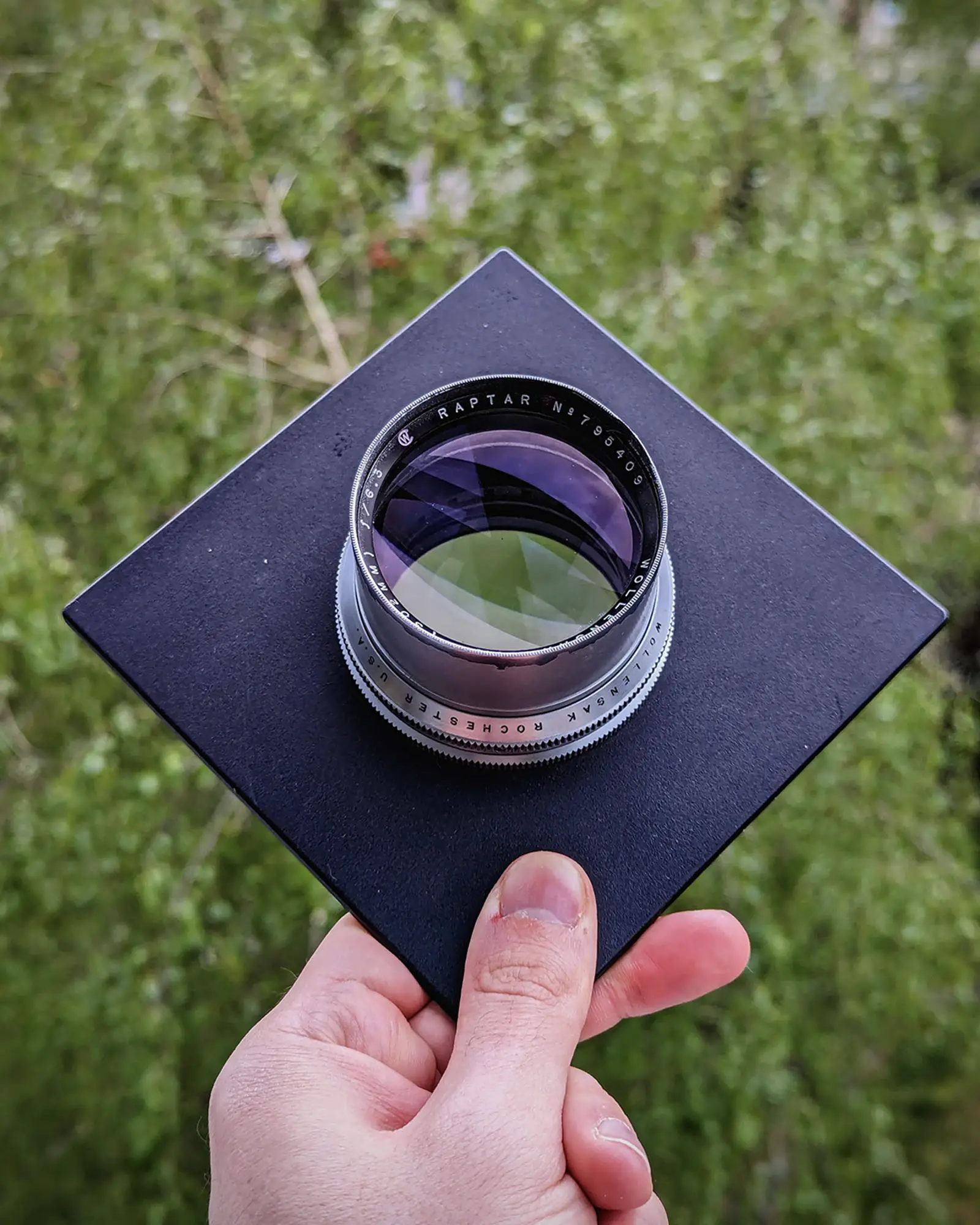
    • The data is not easy to find, but I rolled up my sleeves and dug into the depths of the dark web: it is a Series IV No.5, 12" focal length, later corrected to 11.875", or 302mm. Production was briefly between 1947-1951, the revised piece even only from 1949—so the appearance of modernity is quite deceptive.
    • Update: this is the rarest and final iteration of a much older lineage. In 1912 came the Vinco (and Vinco-Anastigmat), up to 1914 in a slower f/6.8 version. In 1920, Vinco changed clothes and reemerged as the Velostigmat Series IV. And finally, in 1947, the line concluded as the Raptar Series IV. Fascinating stuff!!
    • So feel free to lust after the Vinco and Velostigmat IV as well—apart from possibly missing later anti-reflection coatings, they're basically the same thing. Thanks to my findings, your shopping maneuvering space and financial risk have just expanded significantly. Sorry not sorry.
    • The name "Raptar" came from a public "Name This Lens" contest, won by one Mr. Templin R. Licklider Jr. from Bloomfield Hills, Michigan. He was inspired by the sharp talons and keen eyesight of birds of prey. Congratulations with an 80-year delay, Mr. Licklider—the name is pretty damn tough. Also-ran names included the bland "Colotar" and "Micronar." I can only recommend the extensive info available here.

    Most Wollensaks lying around are shorter focal lengths, often used as cine lenses or for copy and enlarging work (Enlarging Raptar, Tasope, etc.). Getting the version meant for actual large format photography is quite a chore, same as with its predecessors Velostigmat/Vinco. One indicator, as seen here, is the presence of a "W" hidden inside a "C" on the front ring—Wollensak's "WOCOTED" mark for their advanced anti-reflection coatings. These appeared only rarely on lenses not intended for photography. You can also spot them by the lens surface tint: bluish to purplish and, in the right light, downright sexy. But beware: the coatings weren't applied consistently, and not every post-1947 lens has them.

    Alongside the sensual coatings, this one also sports an unusual silver-chromed brass finish, which will surely awaken inappropriate feelings in more than one photographer. The lens is very light and compact, ideal for field work. The many-bladed aperture is just a little bonus on top.

    I'm a man of wide-open apertures, and the mere mention of the f/64 group makes me wave my hands while everyone wonders why my eyes are huge and I'm foaming at the mouth. So it's a lovely trait of the Raptar that it is unbelievably—I repeat, unbelievably sharp wide open, with strong contrast, great depth of field and bokeh. A rare combination that makes it a truly universal piece of glass for nearly any situation. If I had to nitpick, it would be the slightly slower f6.3 speed—a mild annoyance for portrait work, though with group photos you're stopping down like mad anyway.

    Much like the Heliar, I take it when I've got no idea what awaits. It takes no space in the backpack and doesn't murder your spine. It especially shines with larger groups thanks to its flat field and edge-to-edge sharpness. That's mighty handy when you've got several rows of photo-hungry crowds behind one another.

    And let it be said in honor of this sharp-taloned beast that it practically refused to let me take an out-of-focus picture, no matter the conditions—and trust me, I gave it plenty of chances.

  • Aldis Anastigmat

    Aldis Anastigmat

    Aldis may not have been the largest, best-known or longest-running factory, but it had a surprising number of successes in a variety of industries. And since I'm in an extra-dry factual mood today, you'll find some fascinating and shocking data below!

    • With the full name Aldis Brothers, it was founded by H. L. Aldis and his younger brother A. C. W. Aldis in Birmingham in 1901 after Hugh Lancelot (cool name!) left the famous Dallmeyer. Both were, moreover, mathematicians from Trinity College in Cambridge, and also flirted with astronomy and Sunday afternoon construction of astronomical telescopes—so they must have had some prerequisite for lens-folding.
    • At Dallmeyer, on his shoulders a number of six-lenses anastigmats arranged in three groups were made—Stigmatics. A bold design for its time, going against the established rules, which he later modified and reduced to a completely unique solution—more about it later in the article.
    • However the all-seeing search box of Google, when queried "Aldis Brothers", sternly declares the story of the brothers who founded the Aldi chain. :(
    • The company de facto ceased to exist in the summer of 1951, after being absorbed by The Rank Organisation, where it was still flapping as Rank Aldis for a while before its death. TRO systematically bought up, merged and dismantled other companies too — so Aldis merged with Wray and later Pullin and Hilger & Watts. Taylor, Taylor & Hobson was fooling around by chance aswell and a company was formed bringing them all together—Rank Precision Instruments. This was fairly soon (and shortsightedly) assassinated by TRO, killing several birds with one stone.
    • Under TTH was the world famous Cooke, creator of the famous soft-focus portrait lenses. It's not without interest that both TTH and Cooke Optics have somehow managed to survive—the first one now makes various metrology instruments and the latter still makes lenses, yay.

    You will usually find lenses from Aldis designed for aerial photography, enlarging, projecting or copying purposes. However, slide projectors, WWI rifle scopes, periscopes or binoculars also came off from the production line. But the real breakthrough was made by Arthur Cyril Webb with the signal lamp. However, the close ties to the military carried a downside in the production outage of photographic equipment—the motherland took precedence.

    • The signal lamp is used for long-distance communication via Morse code flashes. The Aldis ones went through both wars, but in 1944 the younger brother came up with such an improved design that they were even given the general name of Aldis lamp. It came in handy on the ground in the trenches, on vessels on the water, and between aircraft in the air. I'm afraid I haven't been able to find out whether anyone took it into space aswell.
    • Enlarging lenses are used—beware—in enlargers. With these, one enlarges (sic!) the negatives on photosensitive paper in a darkroom and positively develops them. Yes, it's still being used, and yes, we know there are printers. However, even the best printer cannot battle the good old fibre-based paper.
    • Copying, or reproduction, or process lenses were used for duplicating various documents, scientific work etc. You can find out how they differ from normal photo lenses here. You can read something about aerial photography from my article here.
    • Projection lenses are—oh yeah—in projectors. Whether those for filmstrips or slide projectors. I won't put links here anymore, or Wikipedia will think someone is DDoSing it.

    I need to bow to those who fought their way through the article to this point and I am finally going to reveal to them the truth about the protagonist of today's article. The wars, the army, later acquisitions and the change of course—all had an impact on the rarity of Aldis' true photographic lenses, which were thus produced in relatively small numbers and for a short period of time—especially at such long focal lengths. This makes the unusualness of their anastigmats as such all the more interesting—it is not a conventional scheme which is everywhere, but a completely unique UNO design invented and used exclusively by Aldis.

    • The difference lies in the two cemented members in front of the aperture and one biconvex lens at the rear. Conventional anastigmats carried a different arrangement, either with multiple elements or the same but uncemented arrangement. This scheme, according to the promotional material of the time and assured reports from users, was supposed to bring, for example, improved contrast - but the actual visible difference would be IMHO highly indiviudal and homeopathic.
    • The marking and use of the UNO design by this company is very inconsistent and confusing—sometimes the barell is marked, sometimes not. In later years, the company also switched to conventional three or four elements designs without visually marking the changes. Thus, without disassembling the lens, you can rarely be sure (unless UNO is marked on the lens body).
    • The UNO and its successors (TRIO) also functioned as casket sets, whereby adding, removing, or swapping elements and secondary lenses changed the focal lenght, hence the aperture and scheme. They were thus a kind of primitive predecessor of today's zoom lenses. Complete sets, however, have rarely survived into modern times in general—in this case, it's a Sisyphus-like effort in search of them.
    • Arguably the rarest item in the portfolio is a series marked Series 0. These were portrait anastigmats with f3 aperture and a separate ring with adjustable soft-focus effect. A true blue blood testifying to a skill that few have achieved.

    The output (for chart lovers it is a later revision of the Series III No.10, 16.25in/400mm f7.7) is just sharp enough with very nice contrast and enough coverage for the 8x10" format (when fully open it will cover 10x12" at infinity, so it has plenty of movement on the smaller formats). The lens is also, like the triplets, very amenable to "fake" soft-focus, which can be adjusted by screwing the front—the result is pleasing and not unlike much more expensive specimens designed for this purpose. Its pleasant weight and small dimensions thus predestine it for universal use under almost any conditions and requirements. And thanks to the unusual dark bronze-gold lacquer on the brass body, it's also nice to look at.

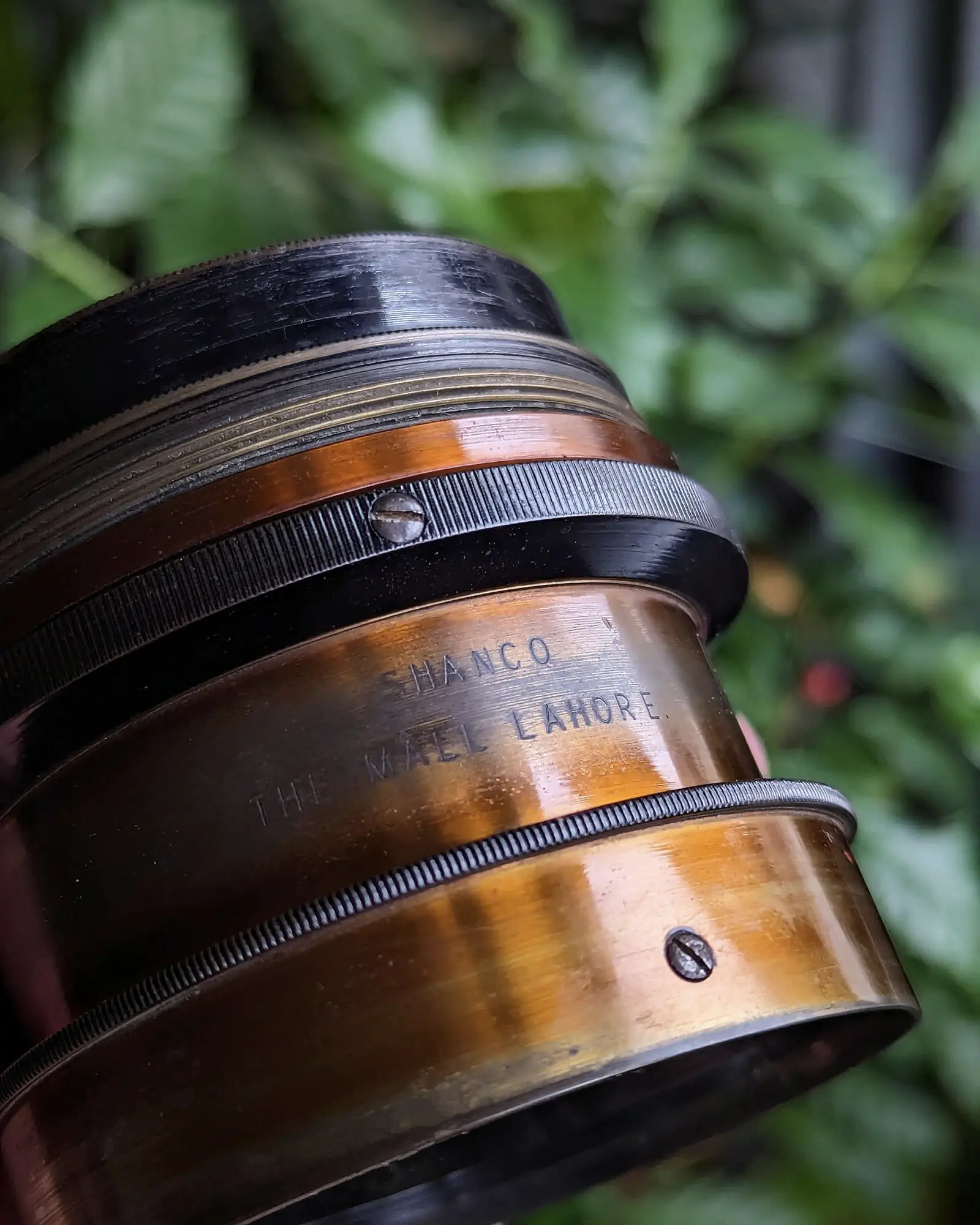
    Over the years I have only come across two examples—both in my hands—and both with experiences from the Indian subcontinent. The first served for many years under the British colonialists in a studio in Bombay and then in Kerala, where it also remained after 1947 and independence from the British Empire—before coming to me in Prague. The second found a home in Pakistan, as evidenced by the signing on the body—"Shanco The Mall Lahore." The meaning of the first words remains unclear; but Lahore is the largest city in the country. Pakistan separated from India in the same year as the collapse of the British Raj, but unlike the first case, this piece has returned to its motherland... before he came to see me in Prague.

    The presence of imperial technology in the territory of the Dominion is not surprising, yet the level of Aldis presence in this particular part of the Commonwealth surprised me and I searched for the reasons. In the dusty shelves of British university libraries I eventually found a plausible cause - the family had lived here for some time and Lancelot was born in Calcutta in 1870 before being sent back to England at the age of five. He seems not to have forgotten his native land and he kept it well supplied with his factory toys. Thanks for that, almost-knight Lancelot—I immediately look at your lenses differently, wondering what exotic adventures they must have had and will no longer tell.

  • Dallmaer

    Dallmaer

    Once upon a time, beyond nine mountains, nine rivers and one English Channel, there was once a Dallmeyer company—I recommend paying particular attention to the position of the letters in the name, it will come in handy in a few moments.

    • The London company was founded in 1860 by John Henry Dallmeyer after he had been apprenticed to the equally famous Andrew Ross and even married his daughter. What was the dowry? The lenses? What a dream! Anyway, the company has become one of the most famous and best (not only) lens makers in history—and it's a rich history.
    • To this day, the Dallmeyer name has an unshakable position amongst large format photographers. Surely because for example the great and glorious B line (speedy petzvals of uncompromising quality) or the D line (better corrected petzvals with greater coverage but also lower aperture). Again, I just have to recommend the photographer's bible—the Lens Vade Mecum.

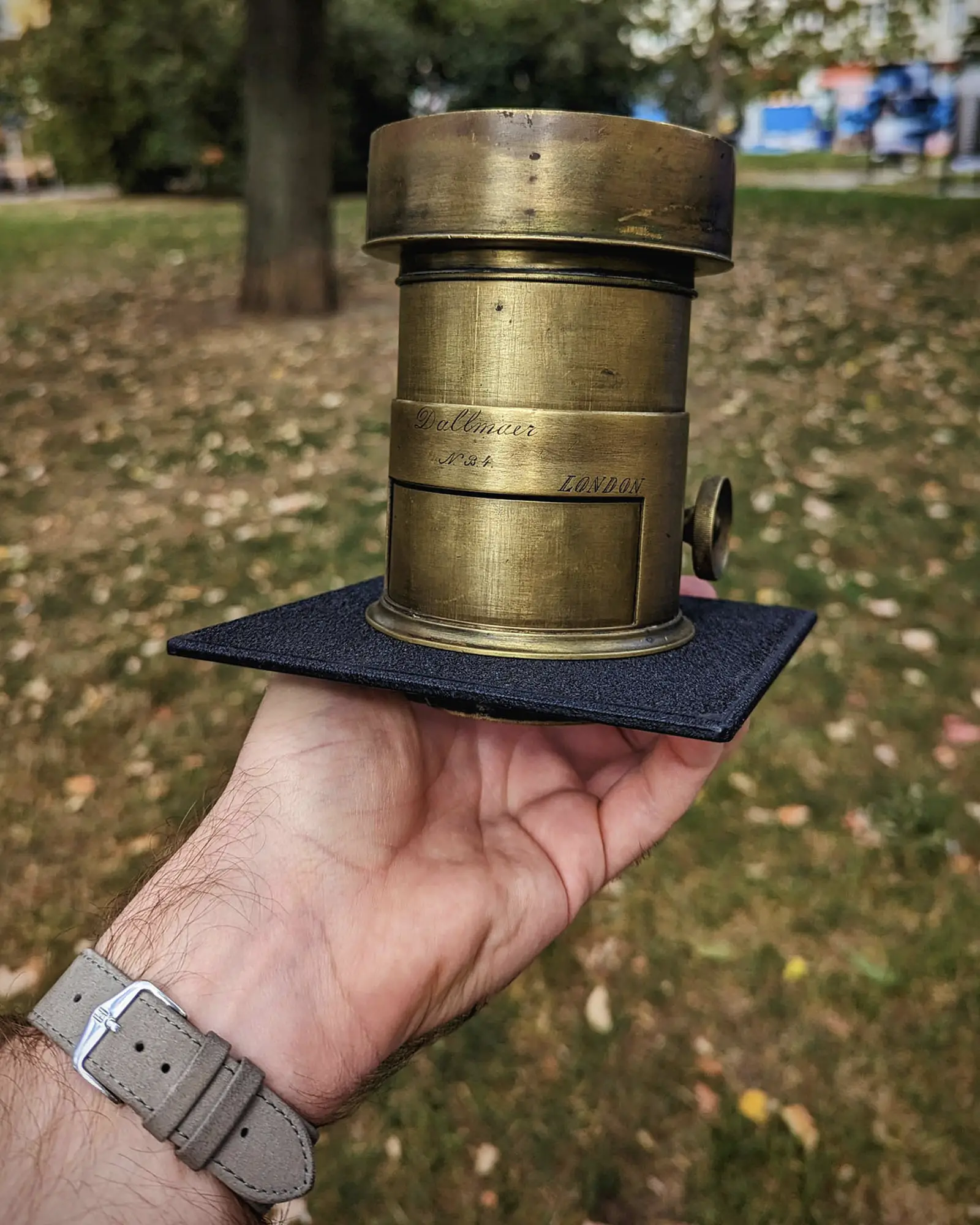
    Anyway, this is a beautiful brass Dallmaer 380mm f5.6 standing in front of us. Not a Dallmeyer, but a Dallmaer. Trouble is, the maker of "Dallmaer" never existed and there are no records of anything like it. What's going on here? There's more than one option, so let's try to untangle this Gordian knot a bit.

    Option one

    An engraver working at Dallmeyer's, the night before his shift in the pub, put more effort into the drinking than he had planned and in the morning, while engraving, still wrecked, he didn't master the alphabet at all and a few letters got mixed up, some fell out, but it happens, who is without sin, let him cast the first lens, right. But in that case, half the factory would have to be smashed—such a lens passes through the hands of many people and especially the quality controller of the final product.

    So unless the inspector was also an engraver or the company employed a blind man or the local imbecile, this option doesn't seem likely to me. It is also contradicted by the fact that no Dallmeyer ever wore the N. B. 4 markings (the 4B is the closest, but it was a lens of completely different specifications and appearance), and judging by the combination of dimensions, focal length, and aperture, no such lens was even produced. Which brings us to version number two.

    The second version

    It's just a fake. Forgeries have always been made, for everything and everywhere—and lenses, as a very expensive item, were no exception.

    • For a very long time after the invention of photography, this field was the domain of noblemen or other really rich people or professionals. Everything was expensive, and it required a great deal of knowledge that poorer people did not have. It was not uncommon for cameras or lenses of premium qualities to cost as much as a house on the square.

    But there are indications that also contradict this variant. In the first place, it would be a very, very high quality copy that can proudly stand alongside the original in appearance (except for the engraving, which is clearly a horror) or performance. What's more—by the various parts of the lens, the manufacturers can usually be pretty well identified and this is highly likely to be the original.

    • The best identifying marks (apart from specific engraving styles or laquere colouring) are usually the lenshood, flange, the appearance of the soft-focus mechanism (here typical Dallmeyer I-IIII notches in the rear) or the rack & pinion system.
    • Rack & pinion is the name of a wheel with a rod on the chassis of some old lenses, which was used to move the body back and forth on cameras that did not have a bellows and were fixed.

    Sure, the dude was just handy, he could be. But why would he put so much effort into such a precise fake, and with specifications that the manufacturer never produced? Shall we untie the knot for a third time?

    Waterhouse stop system

    Option three

    The original, which has been deliberately modified. It used to be quite common that the lens was made without the waterhouse stop system and then added back to the lens maker at the customer's request for an upgrade.

    • It is a system of insertion stops, so called waterhouse system. It is the successor of the older "washer" systems and the predecessor of the aperture blades we know today. A hole was cut in the lens chassis, into which metal inserts with variously sized holes were inserted, which regulated the amount of light let in and therefore the aperture.

    However, such an intervention could have destroyed the original engraving, which the owner decided not to leave alone and, intoxicated with confidence in his own engraving (in)abilities, he wanted to put it back to it's former glory. After careful examination of the lens body, there are indeed indistinct remnants of the original engraving. This option would seem the most likely, though one wonders that such grammatical fussiness followed such careful preparation. Well, not everyone can read. But the careful reader is still puzzled by the remaining discrepancy...

    ...that the lens doesn't fit none of these theories. According to a combination of dimensions and specifications, Dallmeyer never made anything like this, but it is still at least largely original. The threads are tangled, the catharsis does not occur, the Deus ex machina is not coming.

    Be after all the unsolved mysteries it's a really great lens—for both portraiture and landscape work. At the minimum soft focus level it's nicely sharp (though not overly so, the rendition is creamy and typically softy overexposed in the highlights), and at the maximum the output is nicely soft and dreamy, though not pictorialistically so. Bokeh and swirl are very nice, all in a compact size and with enough coverage for infinity at 8x10".

    I'm no Alexander the Great in Gordion, so I won't be dissecting this mystery—and that's actually a good thing. Not all secrets should be revealed—and this lens has enough of them and nobody's gonna take them away anymore.

  • Hugo Meyer Atelier Schnellarbeiter

    Hugo Meyer Atelier Schnellarbeiter

    Today we're going to talk about brass and aluminium. This lens is made of brass and aluminium. We've done our education on the materials side of things, and now we're going to please the linguists—it's a Hugo Meyer Atelier Schnellarbeiter 310mm f3, which the translator peculiarly translates as "fast worker."

    • The term speed in photographic jargon embodies aperture—the larger aperture, the faster the lens (because you can use faster shutter speeds, duh!!).
    • I was reprimanded by a reader for calling it aluminum, when in fact it's an aluminum alloy. I'm pleased that the article stirred up debate even among metallurgists. Hopefully at least the brass is actually brass.

    Anyway, this lens was born sometime between 1910-1914 (soon afterwards there were troubles with aluminum aluminum alloys shortages caused by WWI). It was the absolute top of its time and the showcase of the Hugo Meyer company, which apart from the absolutely insane f3 aperture (only a few manufacturers in history managed to reach or perhaps surpass this mark) is also evidenced by the use of selected materials ensuring low weight despite its size or the not very common presence of a really-lot-of-blades aperture.
    • Besides the smaller siblings, there were also two larger variants with focal lengths of 360 and 400mm. Even rarer, even more monstrous. You might also come across black-and-gold or just gold-colored specimens. Come to think of it, this particular gold-and-silver combo is probably the one I've seen the least.
    • You're not going to impress anyone with an f3 aperture these days. But back then? Hell yeah. Plus—today's lenses can barely cover a few centimeters and even at that, they get out of breath. This behemoth will cover about 18x24cm and believe me—f3 aperture on FF or APS-C is really not the same as on large format. Here, that means you have a depth of field (DoF) of about a millimeter or so and hitting what you want sharp requires the hands of a surgeon and a patient (ideally dead or inanimate) subject to photograph (the ladies below were live during the shooting and I hereby pay tribute to them). If you wanted to convert the aperture on this format to 35mm (FF), you'd come up with some number from dreamland—f0.5 or some such monstrosity). Impressive.

    The sharpness in the centre (the centre of the picture, not the city, it shoots sharply even on the edges of towns and villages, ho ho) is absolutely nuts for something made 110 years ago—towards the edges then stands out the pleasing swirl bokeh typical for petzval designs.

    • I'll probably bring some coal to Newcastle, but just to be safe: bokeh is the out-of-focus part of the image behind the focused object. The more open the aperture, the blurrier the background. The quality and shape of the bokeh depends on the construction of the glass, the shape of the aperture or even the number of blades. The more you close the aperture, the more the bokeh disappears.
    • Swirl is the ability of the lens to "spin" the bokeh in the background—you can see the swirl effect in the second photo. Some designs are famous for it, some don't have it at all. The strength of the swirl effect, like bokeh, is closely tied to the open aperture, the direction of the light, and the ruggedness of the background. It is actually an optical defect of the uncorrected design. And we thanks for these defects.

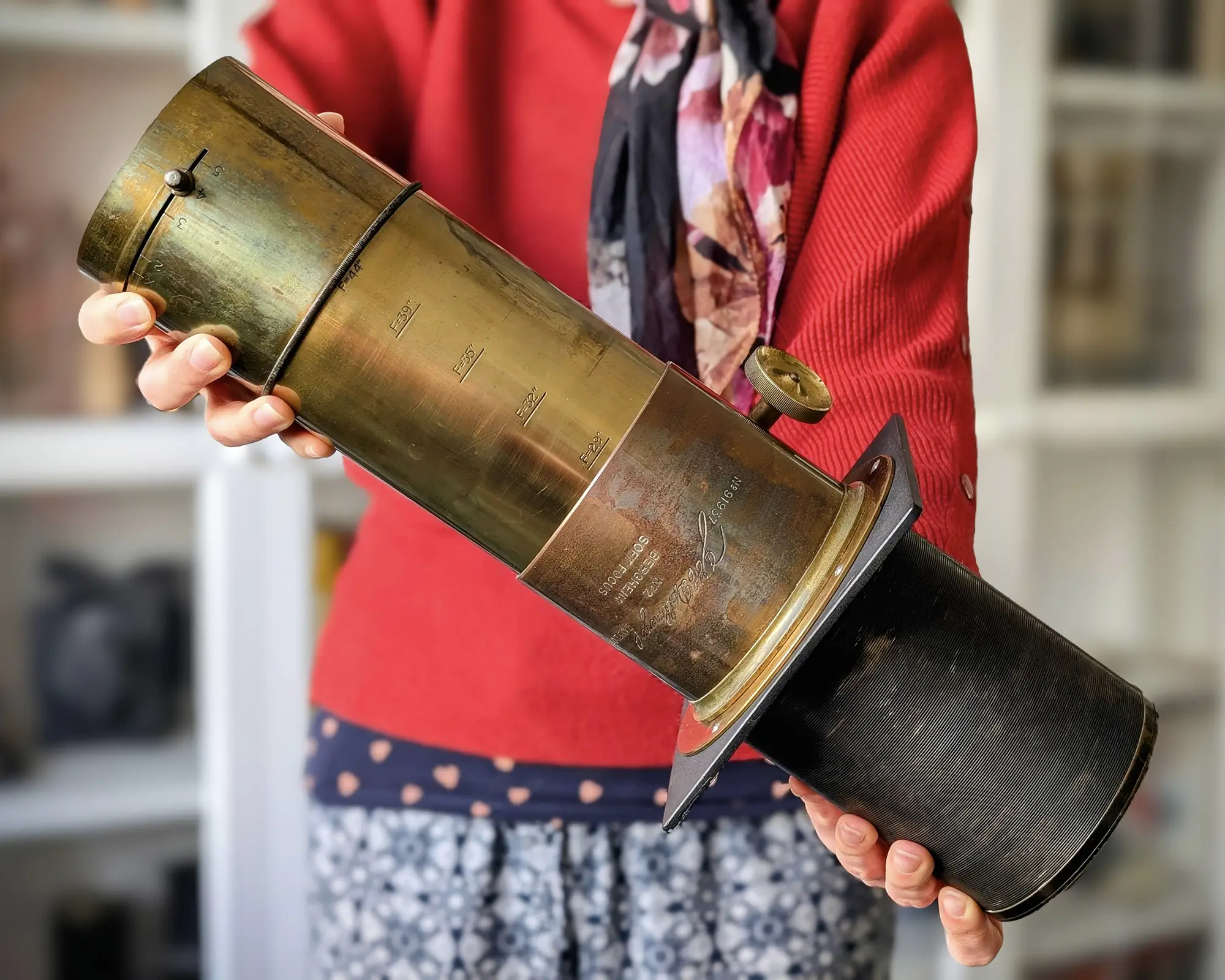
    The obvious drawback should be pretty clear when compared to my delicate little lady hand—it's not small. I dare say it's borderline unportable. I had an entire "Best Of" list of classic jokes ready: The bigger the lens, the better the photographer, or the evergreen Even with a tiny puppet you can put on a grand show, not to mention the timeless crowd-pleaser Hehe, what are you compensating for? In any case, the sheer size of the thing makes it look like someone at Meyer chopped off a piece of an oil pipeline, stuffed it with glass and engraved "ATELIER" on the barrel in massive letters—just in case even the densest moron who's mastered the alphabet gets the hint: this is a studio lens. It's not meant to be dragged outdoors. Naturally, I only ever take it outdoors. But before I had to go through the first problem: adapting it to the camera. It pushed the absolute limits of the Sinar lens board, but hey, it worked. Let that be a comforting note to anyone plagued by self-doubt: don't despair, anyone can take photos. Even a piece of pipe.

    • .