Category: Lenses

Petzval designs, soft-focus, pictorialist lenses… Whatever you wish for. Innovations from the middle of the 20th century and from the depths of the century before. Back then, glass was more glassy and brass was more brassy. Nobody cared about size or weight. Character and bokeh were what mattered, and there is plenty of both here. Leave your pixel-peeping obsession at home and prepare for the perfectly imperfect. These lenses don’t capture photographs. They paint them.

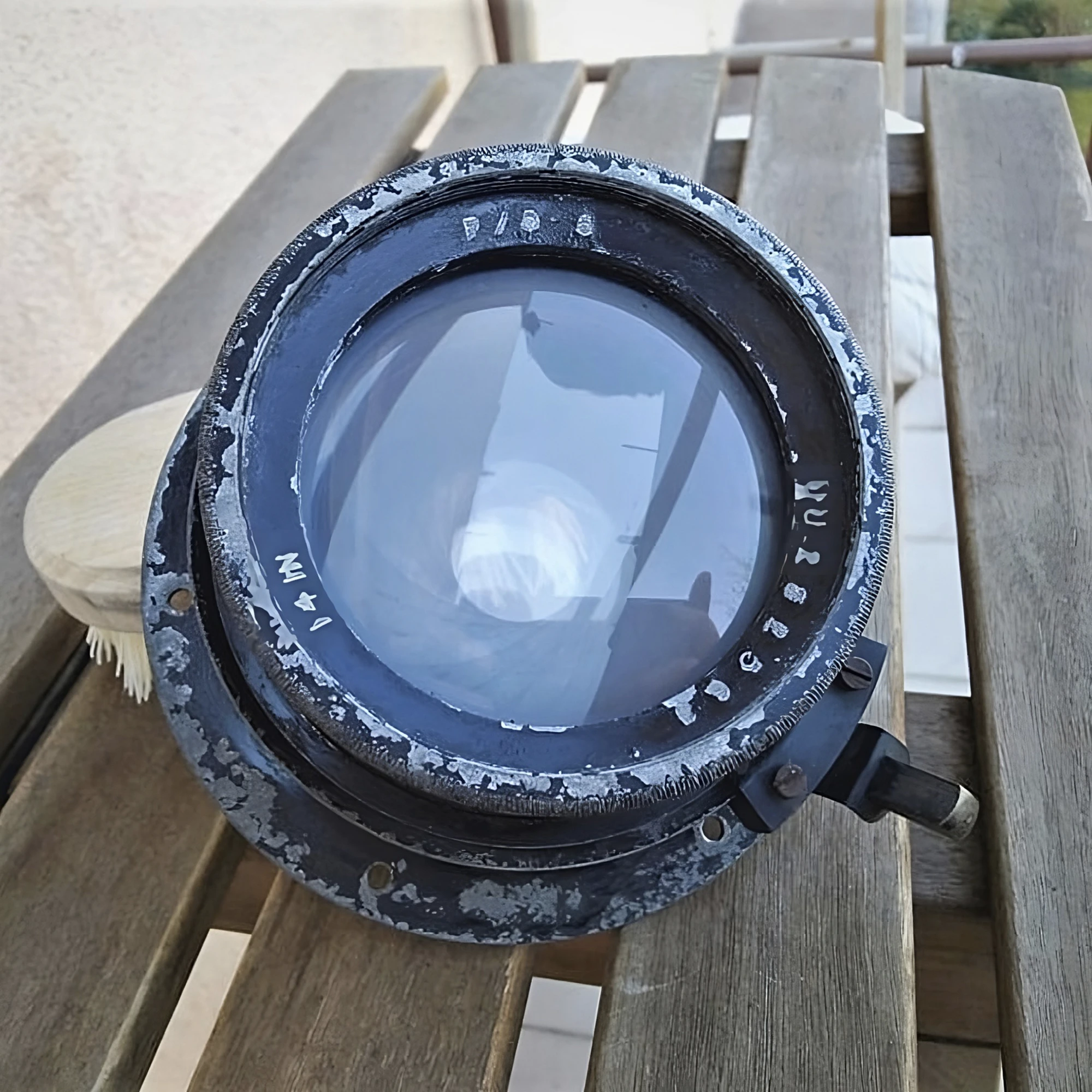
  • Dallmeyer Serrac

    Dallmeyer Serrac

    There were loads of aerial photography lenses. Shitloads. Companies jumped into making them when the war machine needed 'em—even if they'd previously done something else like binoculars or other optical thingies (hello Aldis!). Or they pivoted from commercial optics, either partly or completely - cue Dallmeyer, Wray, Ross, TTH, Burke & James and the others from the lens gang. Production was frantic and markings were... let's say, "optional". Sometimes you'd identify a lens by number, symbol, or a tiny design quirk. Sometimes you wouldn't ID it at all.

    • Lenses came marked with all sorts of anything—for example a crown, one of the many RAF symbols.
    • Dallmeyer also sometimes engraved a stylized J.H.D. (for founder John Henry Dallmeyer) in every possible way: with dots, without, in a circle, freestyle.
    • Then there were (or weren't) codes like AM 14A/XXX-X. "AM" stood for Air Ministry, the 14A bit was the start of the contract code, and the rest... in Dallmeyer's case, those digits often matched the aircraft part the lens was mounted on - usually a Spitfire or later a de Havilland Mosquito.
    • Some specimens had the W↑D symbol—meaning they belonged to the War Department.
    • And during the war, Dallmeyer got fancy and cooked up their own anti-reflective coating. They called it Dallcoat, which was magnesium fluoride (MgF₂) applied on glass. Near the end of the war you'd sometimes spot lenses with a "DC" engraved on them—that was your cue.
    • Oh, and serial numbers? They started with two letters, often your only hope of figuring out who the hell made that. "UU" was Dallmeyer, "TT" Taylor, Taylor & Hobson, "VV" Ross, "No." or "EE" was Aldis and "NOC" = National Optical Company—a TTH offspring churning out war glass.

    None of this followed the usual peacetime rows and logic. Markings commonly shifted without warning, records were lost, skipped, or never written at all, and the whole affair unfolded in a cloud of urgency, shortcuts and indifference. What we ended up with was a glorious pile of inconsistent engravings, serials with trust issues and styles that resemble something like typographic roulette. You could spend your long, lonely winter evenings trying to make sense of it. So, what do we know about the Serrac above? That it was made between 1939 and 1945. That's it.

    Like I said earlier—there were a LOT of types - Pentac, Serrac, Rareac, Dalrac, Dallac, Dalmac, Perfac… Someone in the naming department clearly had a thing for symmetry or a stroke. The one that shows up the most? Probably Dallmeyer Pentac 200mm (8") f/2.9. A sort-of knockoff of the famous American Kodak Aero Ektar 178mm f/2.5. According to legend, every Spitfire had two of them - one on each wing (see diagrams below).

    The 360mm (14") range was mostly covered by Dallmeyer, 500mm (20") belonged to Aldis and the Big Bertha - 900mm (36")—was carried by Wray. Not that it really matters—everyone built everything, lenses got swapped like socks and wartime production wasn't exactly a fan of order.

    In the darkest days of Britain and Europe, Dallmeyer did something that, seen through today's market logic, feels almost unthinkably chivalrous. Rather than splinter its production capacity in the endless chase for profit (not that they were running a charity though), the company focused fully on supplying the military effort. No double-dipping, no hedging bets between the front line and the commercial high street. They tightened operations, prioritized the war machine and even took time to boost national morale. Below are excerpts from wartime press materials (mostly sourced from an excellent reference linked here) and even a catchy acrostic:

    During the pre-Christmas seasons of 1939 to 1944, the factory regularly released upbeat little notes into the advertising ether, confidently predicting the war would soon be over—until eventually, they were right. In the September 1945 issue of Trade Bulletin magazine, they finally nailed it: a half-page ad appeared with a headline that said it all, with all the relief of a deep exhale:

    PEACE

    "The door is now unlocked, and Dallmeyer lenses will soon be once more available for distribution by the photographic and cinematographic dealer."

    Alright, enough history lessons—let's get back to the actual shooting. For aerial reconnaissance, they used super-fast optics with the widest possible coverage, so you could snap as much ground as possible even when the light sucked and weather was British. These lenses were mounted under the plane (where else, seriously?), and the combo of speed, focal length, and coverage meant one thing: these were massive, heavy beasts. They often paired with giant shutters and automatic film feeders that churned out film by the kilometers. Fucks given about size or weight: 0.

    • Films came in all sorts of formats—single sheets or rolls—and were closer to technical films used for copying or scientific purposes than your average everyday film. The main priorities were high resolution (lines per millimeter—lpm), sharpness and boosted contrast. They even sometimes used special developers—forget your normal photo lab chemistry.
    • LPM (lines per millimeter) measures how fine the detail your lens and film can resolve. The higher the better. If your winter evenings are still too long and boring, feel free to dive into these links here or here. GL & HF.

    From the looks of this particular Serrac of mine, he was spying and shooting 24/7 (or maybe the British pilots were dropping him from the plane when they ran out of bombs). However, despite having obviously done a lot of flying in his long life (no pun intended), he's perfectly fine—yuck on the ouside, huzzah on the inside!

    • The oddity is the minimum aperture of f16—that's quite small for a large format lens and some, mostly older landscape lenses, barely started at that aperture. Clearly, for aerial photography, aperture was more important, so they usually didn't stop down too much.
    • Oh and beware, updates!! For years I lived under the foolish assumption that, like the Spitfire, I was carrying an f4.5 Serrac on my shoulders, but then I happened to notice that I was a twat and probably had the less common f5.6 version. Apart from that one trace of luminosity the difference is very likely to be tiny or even non-existent.

    Surely he could tell - what dogfights has he participated in? What battles had he witnessed? Whom did he photograph and upon whose head did he fall? Or maybe it was a deserter hiding for decades in the potato cellar, tossed there by some quartermaster? I know one thing for sure, though - I took him for a walk and we took pictures—but this time, against his habit, he took pictures from the bottom up. He doesn't like the backlight at all, but otherwise he was still good, old man.

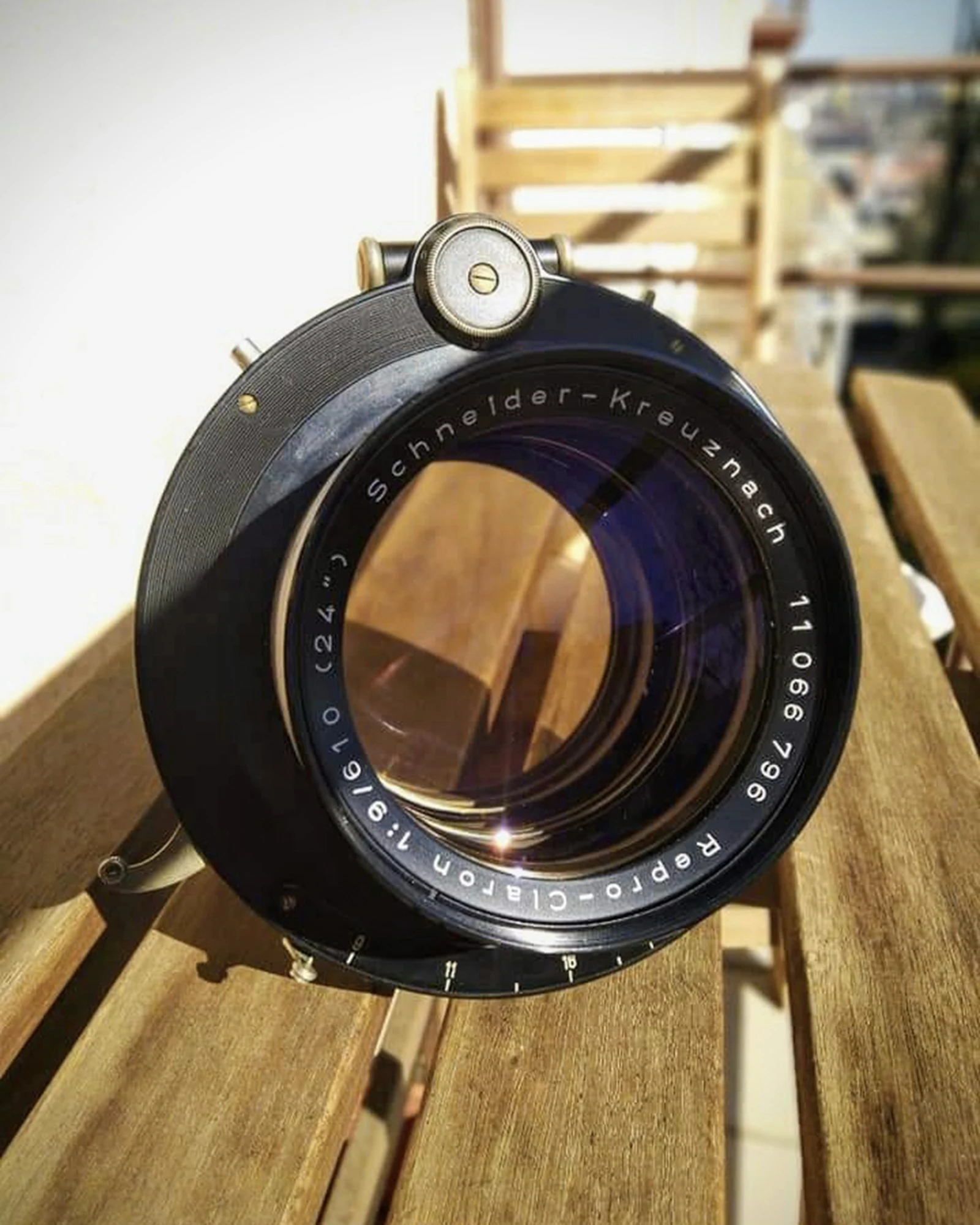
  • Schneider-Kreuznach Repro-Claron

    Schneider-Kreuznach Repro-Claron

    Back then when people thought radiation was basically a vitamin, they crammed it into everything from face masks to toothpaste (Radium girls gives it a thumbs down), optics manufacturers weren't far behind (but hey, at least in their case it actually did something useful, Jiří Zouhar gives it a thumbs up).

    To squeeze out a higher refractive index and cut down on dispersion (yeah, the photos looked a whole damn Röentgen better), they started making so-called lanthanum and earlier thorium glass—meaning the optical elements had lanthanum oxide (La₂O₃) or good ol' radioactive thorium dioxide (ThO₂) baked right into the glass mix. This wasn't just some coating like with anti-reflective layers, but an inseparable part of the glass mass itself where thorium content could reach up to 30%. Because of the radioactive decay of thorium isotopes, the Canadian balsam used for cementing lens elements would turn yellow over time, which, among other things, gave the photos a nice golden tint. The discoloration can be reversed by annealing the glass or exposing it to UV light—just stick it out in the sun, let it marinate for a while and voilà.

    • Thorium in lenses was more commonly used from the 1940s to the 1970s, especially from Asahi, Kodak and Schneider-Kreuznach. Eventually it turned out thorium wouldn't actually kill you—but the fear of thorium definitely killed off thorium.
    • Canada balsam (marginally also Canadian turpentine) is a mixture of oil and resin obtained from the Balsam Fir (Abies balsamea). It is traditionally used, for example, as a medium for fixing laboratory specimens, as it is invisible when dry. When it is mixed in a 1:1 ratio with xylene, it produces a mixture with almost identical refractive index (which is very similar even without xylene) as a crown glass (n = 1.55). This is why it has found applications in the binding of lenses and optical systems. When you don't have anything to do during the long winter evenings and you feel like burning the mucous membranes or teasing the nervous system is the thing, I recommend opening a bottle of xylene.
    • Today's lenses and optics are no longer cemented this way—UV fixation is used. It's an irreversible method (which can be a disadvantage, older lenses could be re-cemented by heat) and does not change over time, so you no longer encounter element separation caused by balm degradation.

    Some lenses have emitted over 3 μSv/h, which is not great, not terrible—however, thorium emits "only" α and β radiation, so as long as you don't eat those lenses or roll around naked in them for long periods of time, you're fine. I guess. Either way, the lens is very nice, it just needs a really big camera or a really long bellows because of the long focal length. In any case—really big muscles. However, it's fun to work with and it's radiating joy and emmiting fun. Heh.

    • Hear the truth: for every millimeter of your lens's focal length, you need just as many millimeters of bellows to focus at infinity. So, if you're rocking a Claron with a 610 mm focal length, you'll need at least 610 mm of bellows to even start playing the game. But wait - want to focus closer? That eats up more millimeters. Want a life-size 1:1 reproduction? Buckle up, because now you'll need double the extension—1220 mm. That'll make you look like a badass even among accordion players.
    • But wait, there's more! Your exposure is only accurate at infinity focus. The moment you extend the bellows, light starts vanishing like dreams and hopes. So you need to compensate - exposure correction for bellows extension. Then throw in filter factors. And just to kick you while you're down, Schwarzschild effect says hi. Well, welcome to Jackass large format.

    Now let's get to the crux of the matter (emmiter?): the Claron. This thing sits in a monstrous Compound 5 shutter and when you slap it onto an 8x10" camera, it turns into a respectable telephoto with a full-frame equivalent focal length of about 89 mm. As mentioned earlier, this means you're gonna need loooong bellows and also strong back—see the photos below for evidence. Coverage-wise, this beast throws an image circle of up to 518 mm at infinity with an angle of view around 46°. That's obscene. The rendering is exactly what you'd expect from a process/repro lens: clinically sharp and contrasty as heck even wide open. Sure, f9 won't win any races in the speed department, but when paired with that long focal length and the sheer size of 8x10" and bigger, you still get a satisfyingly shallow depth of field. The subject pops cleanly from the background, enough to justify throwing around words like plasticity and 3D effect without sounding like a complete tosser.

    • Let's talk about the image circle. If it's too small, you'll end up with vignetting: dark corners, shadowy sides, or in the worst case scenario a sad little circular image floating in black like you used a bad lenshood. But if the coverage is generous enough (like here), the frame stays well-lit, sharp across the board and gives you plenty of wiggle room for all those glorious camera movements—tilts, shifts, swings and whatever will row your boat.

    Give the Claron a proper stopping-down, yank that bellows out and boom—at 1:1 magnification, the image circle balloons to 1036 mm. That's over a goddamn meter. One meter by one meter. What can you shoot with that? Anything. Whatever the hell you want. With this lens, you answer to no one. This chunk of glass will fulfill your most unhinged large format fantasies and still leave a few millimeters of coverage as a dessert. Just be careful at airport security—they might not share your enthusiasm. Try walking through a radiation detector with a thorium-packed artillery shell like this in your carry-on, and chances are you'll be the one fulfilling someone else's wildest fantasies. Someone with a gloved hand and a flashlight.

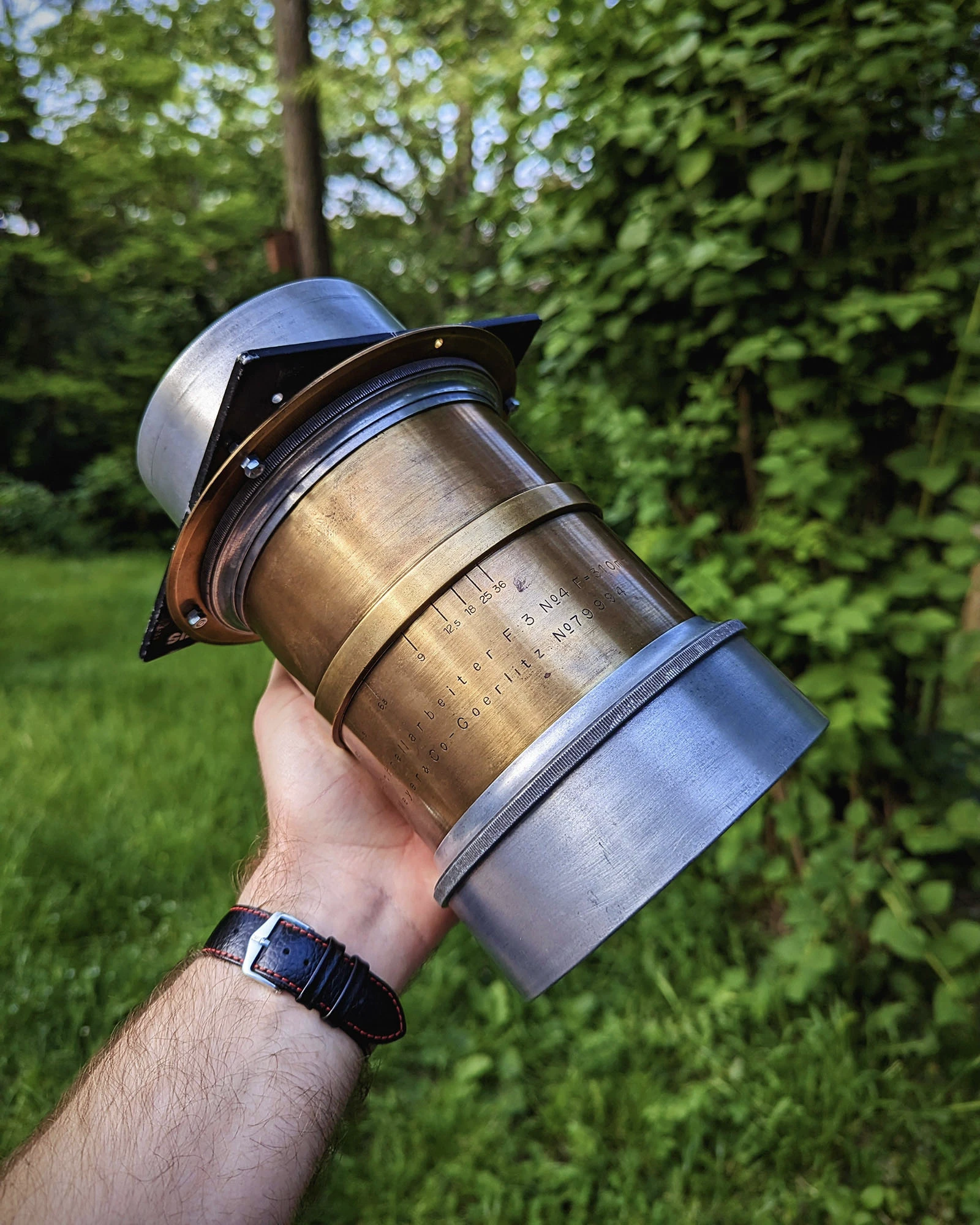
  • Voigtländer Heliar

    Voigtländer Heliar

    What better way to start than with one of the most legendary lenses in history, first introduced all the way back in 1900? The name Heliar is such a prized family heirloom that it has survived to this day and is still in production—though now for digital cameras (I am crossing myself). However, it must be said that the modern versions share no more than the name with the originals.

    • There were a ton of versions—enough to fill an entire book. The pre-Dynar version, produced between 1900 and 1902, was followed by the famous (and by many considered the best) Dynar design in 1903, and then the most widespread post-Dynar iterations, which gradually phased out the Dynar model entirely from the beginning of World War I. Apertures varied (f3.5 to f5.5), as did focal lengths, construction, and dimensions, and later versions even introduced anti-reflective coatings. There was also experimentation with materials—lightweight aluminum alloys were initially favored, but during World War I, as aluminum became scarce due to its use in airframes, production switched to brass.
    • I've owned various types—aluminum Dynars, modern black-brass versions, and even a fascinating Frankenstein hybrid with a mix of aluminum alloy and a later design. You can also come across rare, unpainted golden brass versions (factory-made, I should clarify—if you scrub the paint off with steel wool until you hit the brass underneath, sure, you'll get a gold-colored lens too, but don't you dare!). There are also structurally different aerial versions designed for reconnaissance planes, and I've even seen a model with a textured Schrumpflack finish, similar to German Zimmerit coating. That's the dream—Panzerkampfwagen Heliar, resistant to magnetic mines!

    Though some will surely swear on their mother's honor that there are obvious and glaring differences in image quality between versions, I—begrudgingly—must admit that I haven't noticed any. I'm sure there is a difference (Dynar versions are supposed to have slightly better coverage and tonal reproduction), but alas, my eyes were not blessed with the ability to see it.

    One thing you can be absolutely certain of, though, is that no matter which version you get your hands on, the character of the glass (gangster slang for "lens," reserved exclusively for the coolest members of the photography underworld) is tailor-made for portraiture. The rendering is sharp even wide open (though not excessively so, like with process lenses) but at the same time, it has a velvety, soft, and gentle quality. The creamy bokeh in the background is just the cherry on top. And write this down on your ground glass—stopping down a Heliar is murdering a Heliar!

    Over time, they earned a reputation as the Crème de la Crème of portrait photography—so much so that many prominent figures, from kings and maharajas to movie stars, generals, and common folk alike, refused to be photographed with any other lens. This was especially true for the Universal Heliar. But more on that next time.

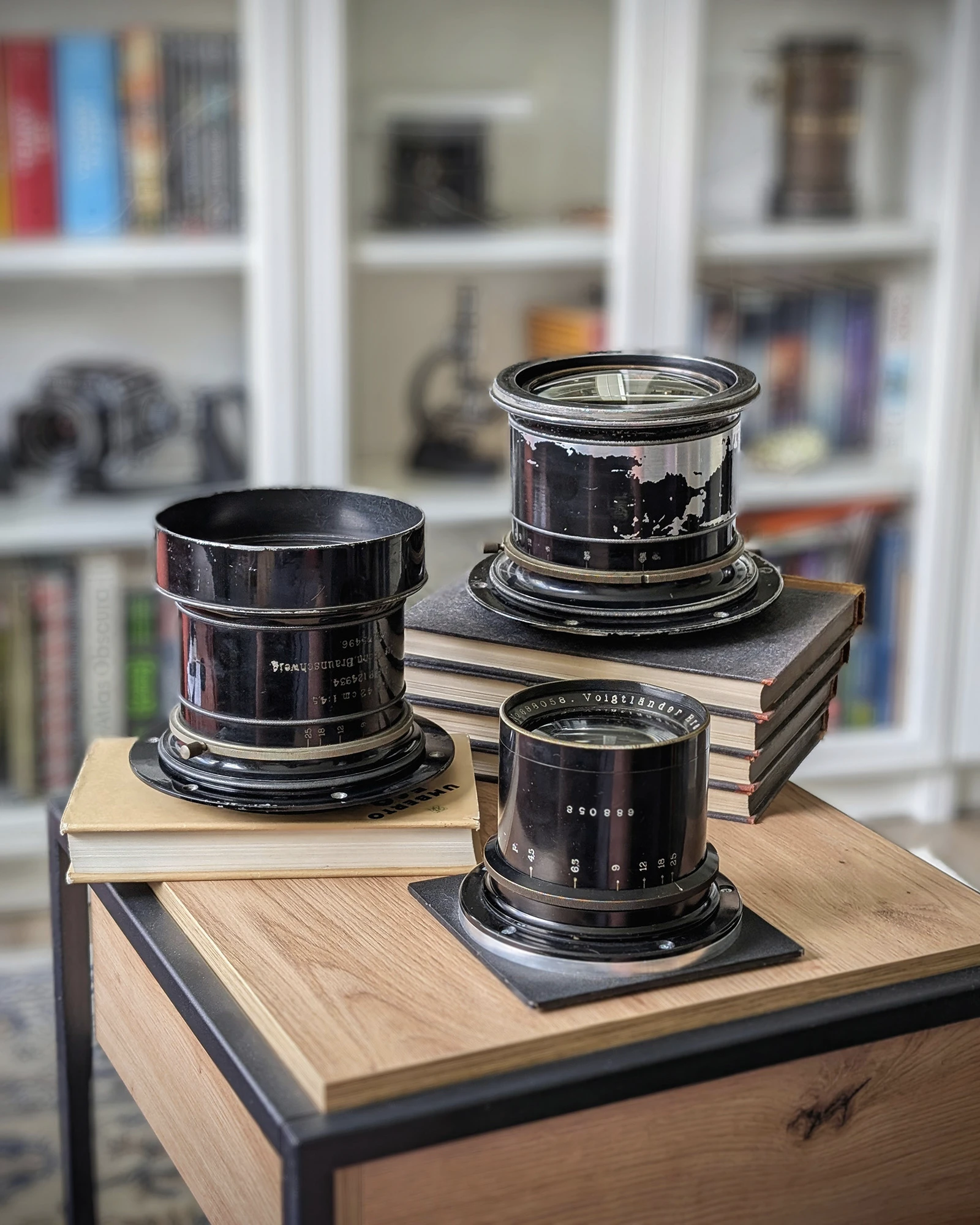
    Now, let's finally take a look at the lovely bunch that had the decency to show up! There were a wide range of focal lenghts varying from those made for 35mm toys all the way up to proper ULF monsters (ultra large format). Personally, I'm into the bigger ones—can't afford a Hummer, so I make up for my tiny weenie with large lenses. And obviously the bigger the lens and the camera, the better the photographer. That's just science. 

    • 360mm f4.5—2,5kg heavy hunk of glass and blackened brass (or, to put it more academically, a modern iteration of considerable weight and refined materials), which is just perfect for eliminating your toes when this totally ergonomic piece of gear slips out of your hands. It features an asymmetrical five-element design, with a cemented biconvex rear group, a convex-concave front group, and blah blah blah—for the handful of eccentrics who revel in optical diagrams, I'll simply direct you to Lens Vade Mecum, the ultimate (and hefty) bible that every lens aficionado should own. For the less committed, Wikipedia or Camera-wiki will do just fine. The coverage is more than enough for 8x10", and even wide open at infinity it shouldn't give you any grief with 24x30cm either.
    • 420mm f4.5—a version an order of magnitude larger, tipping the scales at around 2,6kg. The weight increase compared to the previous one is suspiciously minimal—but that's thanks to aluminum instead of good ol' brass. A distinctive feature are the Heliar knobs for aperture control, which, on standard versions, sometimes appeared only on the 420mm, 480mm, and possibly the 600mm models. Otherwise, they were a signature of the Universal Heliar, where they also controlled the soft-focus mechanism. Their shape and size evolved over time. The projected image circle is obscene—easily 30x40cm, and once you stop it down greatly, maybe even more.
    • 480mm f4.5—well, there I was on a weekend, minding my own business like a proper café-dwelling layabout, skipping the real work in favor of a decaf soy pumpkin spice venti latte - when BAM! Out of nowhere, an absolute coconut of a lens smacks me in the face. One of the rarest pieces of glass ever to roll across this planet. Just another Sunday. Where am I even supposed to put another one? Sigh. Anyway, my current 480mm version is nothing less than a 3.6kg behemoth of glass and blackened aluminum, which, over its long existence must have annihilated entire goddamn battalion of the big toes. Very few were ever made, and even fewer have survived. The price tag back in the day must have been eye-wateringly high, whether you were a commoner or a noble. Unfortunately, the signature hasn't survived, as it was sometimes engraved on the lens hood—which, in this case, is missing (other versions had the engraving on the barrel and a permanently attached hood, so at least you couldn't lose it). The image circle is absolutely monstrous—it swallows a 40x50cm frame like it's nothing. Yes, that's half a meter of photographic overcompensation.

    Wait, what? A 600mm Heliar? Yep, it existed. Entire generations of big toes have been trying to forget. Very, very few were made. Even fewer survived. So just forget about it too.

    • Update: according to Japanese historical optics expert Masayoshi Hayashi, at least 485 pieces of 480mm and 74 pieces of 600mm were produced according to available sources (based mostly on publications by Hartmut Thiele). What's more, there were also custom-made variants not appearing in official catalogues—for example 500mm f3.5 and 700mm f4.5. In the case of the discovery of such a piece, it can be likened to finding the Holy Grail. 

    Slovo Heliar je derivátem Hélia — řeckého boha Slunce. Co takhle postavit se po bok velikánů a nechat se zvěčnit, než nás zas opustí pěkný počasí? Protože jak říkával nebožtík Ned Stark — budiž mu země lehká — zima se blíží! Takže napište a než si poportrétujem, nezoufejte. Uvidíme se u dalšího dílu. Máte to marný, nic s tím nenaděláte.