Category: History & travel

Filmy, chemie, desítky a snad i stovky druhů rozličných historických technik. Expozimetry, nezbytnosti (a často příšerný zbytnosti). Postupy, tipy, zapomenuté drobnosti a užitečné cestičky, které někdo musel bolestivě vyšlapat. Věci, co se nevešly nikam jinam — na povídání je toho dost.

  • Kdy fotografie vyměkly?

    When did photography go soft?

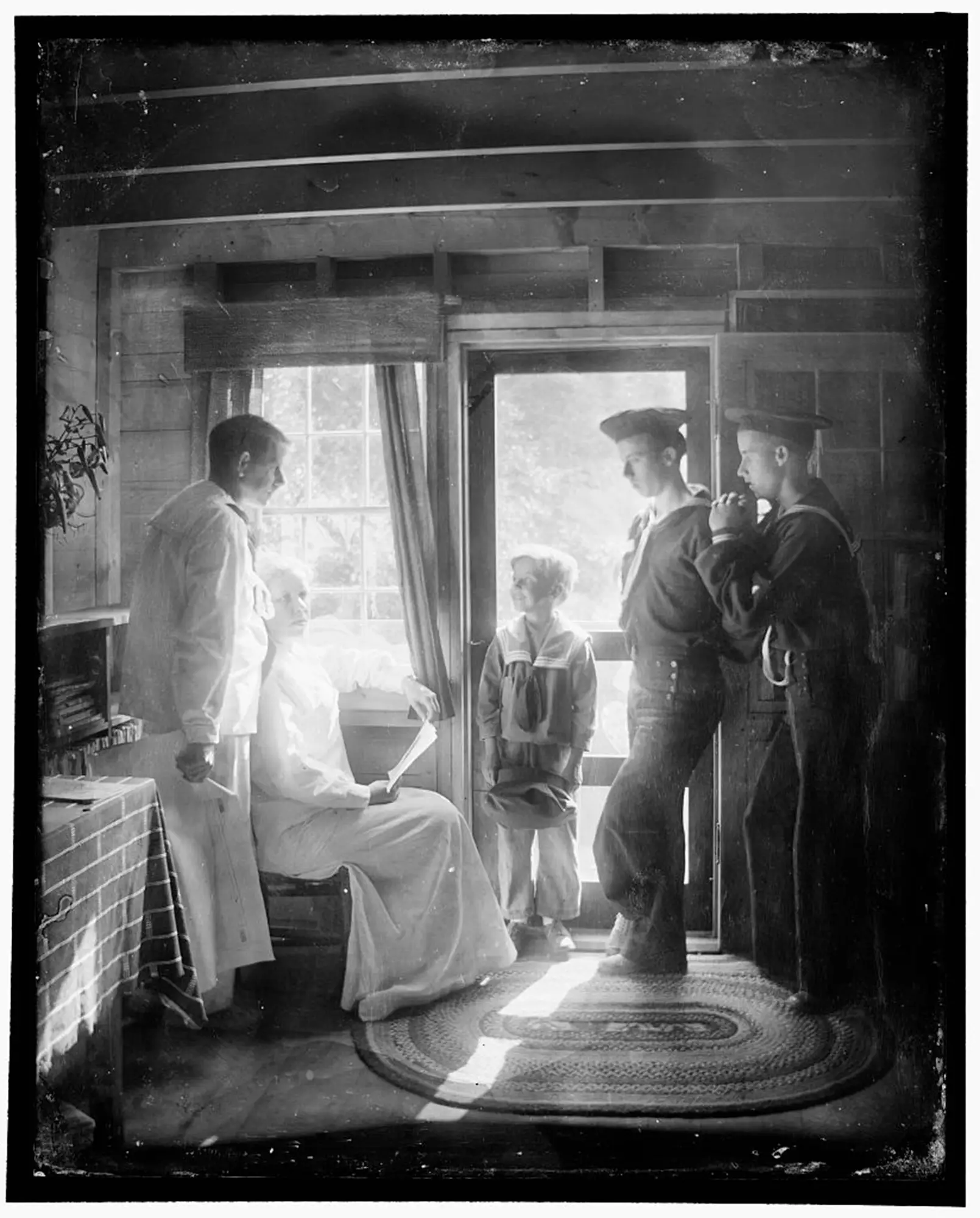
    The Clarence White Family in Maine — Gertrude Käsebier

    Prologue

    Originally, I intended to build this article as a survey of pictorialism; once and for all to attempt to locate its birth, to split apart the already disheveled history of photography and then glue it back together more neatly. But it was starting to resemble an Excel spreadsheet and a dry historiographical dissertation far too much. So I'll take a different route and begin with a paradox: how the pursuit of technical refinement created an aesthetic of imperfection. In my previous article I dealt more with general description and the practical side of things; here I would rather, instead of a broad introduction and skating over the surface, develop the damn why and the hell how. Stretch your menisci, get the vaseline ready, crack open a cold one and let's get to it.

    One might not immediately think that lenses suitable for photography existed long before the invention of photography itself. Optics and lenses had been drawing images for centuries and millennia before that, and this principle was used across fields and disciplines. If I leave aside astronomy (telescopes), naval navigation (spyglasses, sextants), science (microscopes, magnifiers), and the military (sights, periscopes), and focus on art and entertainment, we would find them in plenty of places:

    • Camera obscura—a dark chamber. It consists of a hole in a wall or in a box and that's it. Light passes through a small opening inside and an inverted image of the outside world appears on the opposite wall. No magic, no electricity, just a bit of darkness. The principle has been known for millennia; later simple lenses were added and eventually photographic material. It is the foundation of all photography, and modern cameras are just slightly more sophisticated boxes. Anyone can make a pinhole camera from anything, from a matchbox to an entire room. Or cut one out of a magazine. Or buy a nice wooden one made by Czech hands.
    • Camera lucida—a "light chamber," a gadget for draftsmen. A glass prism or mirror projected the subject in front of the artist's eyes, and he could see both the model and his drawing at the same time. The subject was easier to trace, and he could pretend to be an artistic genius. Then all that remained was to enjoy countless exposed ankles and bulging corsets of enchanted ladies. The device was constructed by the Renaissance-minded William Hyde Wollaston. He also created the first landscape lens, Wollaston—in 1804, more than twenty years before photography. You can still buy a reproduction today.
    • Laterna magica, or magic lantern, or skioptikon, or the great-grandfather of the projector. Inside was a candle, in front lens and a transparent image. The image was enlarged and projected onto a wall, and in the 17th century people would go hysterical over it. For greater effect, smoke was sometimes used during projection—at that point the entertainer was also playing with the Inquisition. A similar shock was probably only experienced later when a silent train by the Lumière brothers came rushing at them.

    That great, enormous leap, then, was not in the invention of the lens or the camera; it lay in the fact that someone finally appeared who didn't let the image disappear.

    In the right lower corner the illustration of Camera obscura — Oculus hoc est (1619)

    I. Limits of the time

    Until recently, the first surviving original photograph in history was considered to be View from the Window at Le Gras by Nicéphore Niépce from 1826–1827. Recently it was beaten by a year by Boy with a Horse (1825), and then there is also Still life of a set table (1823–1825). But there's a bit of boeuf bourguignon in that.

    • The Still life of a set table would be considered the first known photograph (heliograph), if the original hadn't somehow gone missing. The current form is a 19th-century reproduction.
    • The horseboy image is again an imprint of an older engraving. It is the first image created by photochemical means, but it is not a capture of reality nor an image from a camera. The first Xerox. Proof that light itself can draw an image.
    • The roofs of Le Gras are thus, in the judgment of my highly esteemed authority on world photography, the first true surviving photograph. The image was created by an eight-hour exposure on a pewter plate coated with an asphalt mixture. Today you commonly have 1/8000s on your camera. That's more than 230 million times faster. And without asphalt.

    As you can see, the first photographs looked similar to the first digital photographs. Man is driven by the desire for improvement, so it stands to reason that the dawn of the photographic craft was generally devoted to achieving perfection—this fit into the emerging era of realism and the effort for a faithful imprint of the world, for accuracy and objectivity. The stumbling block was the insufficient maturity of the technology of the time. The first achromatic designs were very simple little lenses suffering from all possible optical errors. Lens speed was more like lens slowness (at best ~f15) and sharpness wasn't exactly present either. Pictorialism was still far away, but already now photography was somehow blurrier—not intentionally and beautifully, but accidentally and ugly. Realism was still more in the heart and mind, certainly not in the result. Photography softened as soon as it was born.

    The heads of physicists therefore tried to crack the three most uncrackable nuts of the newly born photography: lens aperture, sharpness, and the largest and flattest possible coverage—and how to combine and improve all of it. It didn't take long before the work succeeded.

    II. Triumph of perfection

    There's probably no need to introduce Joseph Petzval—he created in 1840 the first mathematically calculated lens in the world, the Petzval. It was a revolution in optics, sharpness and speed, which at f3.6 was something unseen until then. However, somewhat unjustly, an earlier giant is a bit forgotten, who just before Petzval significantly advanced usability and photography as a field—Charles Louis Chevalier.

    Charles Chevalier was playing with glass even before photography was discovered, and titans such as Niépce, Daguerre, Talbot, or Bayard worked with his lenses. Like others, he started simply and reached more complex designs with better optical properties in the same year as Petzval. For the French academic society SEIN he presented his magnum opus, the double achromatic Verres Combines. It allowed changing focal lengths by swapping parts of the lens, and the speed improved by several orders of magnitude to f5. Its versatility and elegance impressed the jury so much that Chevalier dominated the competition and won the contest with a Médaille d'Or.

    • Verres Combines was one of the first truly practical photographic lenses. Compared to his colleague, it was less sharp but more uniform across the field and more refined in rendering. Thanks to modularity, it could serve as both a landscape and portrait lens—basically the first zoom.
    • The Médaille d'Or was the highest industrial award granted by French scientific and industrial commissions, which often rewarded unconventional approaches and progress.
    • In early evaluations by the Société d'Encouragement, Chevalier's optics were often considered technically superior to Petzval's design; however, the latter, thanks to extreme speed and better sharpness (albeit mostly away from the edges), ultimately dominated practice and the market. Chevalier won the medal, Petzval won history.

    One last major flaw remained to be cured—a flat field of view—and that took a long time to treat.

    • Lenses corrected for a flat field bend the plane of focus less, and it has a smaller tendency to curve toward the edges—the entire image is sharp and rendered within a single plane. They are very suitable for photographing multiple subjects at once and are essential, for example, in technical and reproduction photography.
    • Designs with a curved field typically let the center stand out—the farther from it, the steeper the falloff in sharpness and the harder it is to bring the edges into focus, even with stopping down. This behavior is typical for Petzval lenses and old meniscus optics. They are particularly suited for characterful portrait photography or more artistic genres, where achieving the most faithful reproduction of reality is not necessary. Once upon a time this was considered undesirable—today it is exactly what people want.

    Progress came in 1866, when Dallmeyer, in parallel with the German Steinheil, introduced to the world the Rectilinear/Rapid Rectilinear, also known as the Aplanat. A number of problems (spherical aberration, coma, distortion, size, weight) were practically solved, while others (astigmatism, field curvature, speed) not so much. The real breakthrough came with Dr. Rudolph, who in 1890 pulled the Anastigmat out of his pocket, and with the Protar (and later the Dagor), everything advanced (I know, I promised not to be dull, so if someone wants to dig deeper into this, let someone else bore you). Truly reproduction lenses came much later, but already now photographers could break the chains of creative limitation and, through the ground glass, see the ideal sought for over half a century.

    The journey, however, is often the destination, and after reaching it, many realize that they have long since outgrown the milestone they had achieved, and it no longer fulfills them.

    III. The aesthetics of error

    Photography first could not be impeccable. Then it learned to be flawless. And then it decided it doesn't always want to be perfect. Soft photography did not arise in a single moment, but through an organic and gradual friction of at least three forces:

    • A new fashionable era—pictorialism is a photographic style heavily inspired by painters, especially Impressionism, Symbolism and Tonalism. I don't want to copy an encyclopedia here, but for the idea: photographs are often (not always!) characterized by a flowing, blurred, dreamlike appearance. They evoke imagination, pensiveness, melancholy, atmosphere and the spirit of the good old days (which of course will never return). Many other approaches strive for the most accurate depiction of reality and claim "this is how it is." Here the center is mood and state of mind—"this is how I feel." The image becomes a carrier of state, light, and experience.
    • Rebellion of artists—when something becomes too popular, a countercurrent appears of people who stubbornly and viciously howl in favor of opposition. Reminds me of someone. Once photography could mercilessly reproduce every grain of reality, part of the authors rejected the role of a mechanical recorder and began searching instead for emotion, expression and intentional difference. Only once photography could be faithful could it afford to be deceptive.
    • A byproduct—what was originally a consequence of technical limitations gradually transformed into a consciously sought expressive tool. (Im)perfection transmuted into a new aesthetic ideology. Or, in other words, how to make a silk purse out of a sow's ear.

    IV. The problem of two kinds

    Flaws, in the name of beauty, began to be refined and cultivated. But similarly to Homo sapiens vs. Homo neanderthalensis, one path, although not worse, turned out to be a dead end. Everyone gets their turn, and the French drew the shorter straw. Any resemblance of the French to Neanderthals is purely coincidental.

    Since I am about as much an optician as a Pole is a highlander, I'll try to explain this as simply as it once had to be explained to me: there were two kinds of softness—chromatic and spherical. Let's take chromatic first: light is a dumbass. It isn't just white, it's made of different colors, you just don't always see it. Take a look at the cover of Pink Floyd's The Dark Side of the Moon. Each color bends differently—red goes one way, blue focuses somewhere else, green decides to sit in between. Instead of meeting in one place, the colors gather like folks going for beer. Each ends up in a different pub, and the image is blurry as if they'd already come out. In color photography it's ugly—it creates colored fringes, nobody wants that. In black and white it's not ugly, but nobody wants it either.

    Now spherical: the lens is a moron. Because it's curved, a ray hitting the center bends differently than one hitting the edge. One here, one there, contrast goes to hell, everything gets soft, scream cuts through the night. In chromatic aberration, colors can't agree where to meet; here, the lens can't decide where to send the light. It doesn't produce a colorful circus and is easier to control in use—so you can probably guess that the one who eventually had to pack their bags and leave was chromatic aberration.

    Lenses that use spherical aberration, unlike the other, evil one, hardly suffer from chemical focus shift. Some designs were not corrected for the full visible spectrum, so optical flaws played a significant role. The biggest problem was axial (longitudinal) chromatic aberration, which required focus corrections. Simply put: the image recorded by the photographic material, due to sensitivity to blue and UV light, was focused in a different plane than the image observed on the ground glass. The human eye perceives sharpness mainly in the yellow-green part of the spectrum. In modern panchromatic films this problem is largely suppressed, but in orthochromatic materials, collodion and other blue-sensitive techniques, it can still be relevant.

    Don't click!

    And pst, psst—neither of these optical bastards ever gave up! These Cinderellas, mocked for a century and a half, still lives and annoys from the shadows. Spherical aberration is occasionally and deliberately used in soft-focus lenses. And chromatic aberration—that's a true, indestructible partisan. Everyone tries to drive it out of modern lenses, but it never fully disappears. Never. ¡No pasarán!

    The French pilgrimage of chromaticity

    Soft-focus lenses intentionally based on chromatic aberration were few, scarce and rare. Most disappeared with the arrival of color photography, because that colorful mess on the edges was apparently not desirable. And just like then, today they are, as they say in Afrikaans, So skaars soos hoendertande—rare as hen's teeth. The people of the Gallic rooster always went their own way, so most of these had no lineage somewhere else. If you want to play with chromatic softness, look for Berthiot Color, Boyer Opale or Puyo/Pulligny. Good luck.

    The most famous of them was the Objectif Anachromatique d'Artiste by the duo Puyo/Pulligny. The history of this brassy tube is exceptionally tangled—I'll try to shed light on it in another article. Behind it stood the hardcorely soft-minded Commandant Puyo, who really wanted it. So he teamed up with optical nerd Jean Pulligny who designed it, and then they turned to Alphonse Darlot who built it. Production later expanded and various offshoots appeared—M.G.O. (Manufacture Générale d'Optique), Derogy, Gaumont, Turillon & Morin etc. They usually had a correction scale for focus shift and were modular—the front element used a bayonet instead of a thread, allowing easy swapping of focal lengths. The lens thus resembled so-called casket sets or early zooms. Finding one is not easy. Finding one complete with all focal lenghts is not easy. If you speak a language where nothing is pronounced as written, go read more here. Hon hon Gaston, omelette du fromage.

    Either way, one path, though not worse, proved to be a dead end. Chromatic error died, spherical fault took the throne. The aberration is dead—long live the aberration.

    The Anglo-American path of sphericity

    This train was started by Dallmeyer with his innovative Patent Portrait series. He took the original Petzval, shuffled the rear elements a bit, tweaked it and voilà—by rotating the rear element, one could now control spherical aberration and thus soft focus. It wasn't the main purpose, more of a bonus, but it didn't matter. The foundation stone was laid and chaos ensued.

    Gradually, more types, variations, copies, improvements and fixes appeared—the Earth spun and lenses spuns. Women, children, everyone frantically twisting rear elements and reality went soft. And once again it was Dallmeyer who, toward the end of the century, stoked into the locomotive's boiler. The Dallmeyer Bergheim saw the light of day. John Simeon Bergheim, a mining engineer, painter and photographer, was the impulse behind the first lens in history deliberately designed for pictorialism. A visionary whose work became a bridge between two originally opposed crafts—the brotherhood of the brush shook hands with the guild of the bellows. Ideas merged and love reigned. History nearly forgot him, but that doesn't change the fact that the name Bergheim will not be erased from books nor scraped off lenses. Ladies and gentlemen, I don't mean to offend, but how many of us can say the same?

    The lens itself is extraordinarily peculiar. It achieved its desired look through the cooperation of both defects—chromatic and spherical—and most models had variable and very long focal lengths. It was also a telephoto design, so focusing did not require such a long bellows. Given the extreme focal lengths, that was quite useful. It suffers from focus shift, aperture changes with focal length, the aperture scale isn't standard, focusing is extremely difficult… The interplay of all this makes it the most complicated lens I've encountered so far—before I took my first photo with it, I managed to get soaked, dry off, and get soaked again.

    So we have softness as a bonus, softness as a purpose, and… what about softness as an accident? Allow me to introduce the Taylor, Taylor & Hobson Rapid View. This almost forgotten piece from the second half of the century of electricity was just one of many simple, cheap landscape lenses. No fanfare, no expectations. A simple, largely uncorrected rear element, aperture in front, terrible speed around f11, so so sharpness. The optical fairies were having a bad day. But then it turned out that if you unscrew a small tube and expose the bare glass, the speed increases and the lens goes crazy. From an average landscape lens it suddenly becomes a radical soft-focus lens—delicate rendering, magical 3D effect, low price, tiny size. My 325mm version, once disassembled, is only a few centimeters long—hard to believe it covers an 8x10 format.

    The company shamelessly capitalized on this unexpected success and later released the Rapid View Portrait—essentially the same lens, just with modified housing and expanded aperture mechanism. Higher speed, no need to disassemble anything. The little thing turned its handicap into an advantage and successfully evolved. Someone at headquarters was probably popping champagne.

    Non-epilogue

    The past of artistic photography reminds me of Hegel's dialectical system—history sometimes moves forward only through the clash of opposites.

    • Thesis—dreams of flawless photography. It must be perfect. Forward!
    • Antithesis—a split and apparent retreat. Perfection is suddenly sought in imperfection.
    • Synthesis—the realization that the ideal is achievable, but not always desirable. It is a matter of choice and sometimes coexistence.

    Like many other movements, even this one experienced rise, peak and fall. Its popularity soared, until dreamy ornamentation was brutally cut short by the harsh reality of World War I. Afterward, photographic impressionism sang its swan song, but briefly. So perhaps it would be fitting to carve an epitaph on the tombstone of pictorial photography and finally ask, when soft photography died:

    Never. Never!

  • (S)Rázná Albánie — nohy bolí, spojka smrdí

    Abrupt Albania—sore legs, smelly clutch

    And there's also rakija. Overtaking in blind corners. Blood feuds. Ancient towns. Hospitality. Untamed spirit. A lot of lamb and mutton, fig jam. By now you can probably tell there's a lot lurking here. Time isn't infinite, and since we prefer getting to know at least part of something properly rather than skimming everything superficially, we mentally cut the country in half and head for northern spring Albania. It has to be photographed too, so I once again submit myself to the usual torment and pack my analogue junk. No reinventing the wheel. I take the same kit I used when conquering Greece:

    • A square-shooting Rolleiflex SL66 with waist-level finder, one back and three lenses: Opton Di 50/4, Opton Planar 80/2.8 and Opton Sonnar 250/5.6. Along with that, my trusty Gossen Profisix light meter, a stack of black-and-white films (Ilford FP4+ and HP5+), a polarizer, three Softar II filters (because pictorialism must exist everywhere in the world, even in the Balkans!!), an ND1000 neutral density filter, a carbon Rollei tripod, and some small thingies: cable release, lens hoods, cloths, hex keys, strap and so on. A lovely five kilos. I carry it all in a cube strapped to my chest, which reliably allows me to sweat out a Mickey Mouse.

    I—How do we get there?

    I—si do të shkojmë atje?

    Everything is planned (not too little, so we don't end up bivouacking in a ditch near Tirana and getting gnawed on by local dogs, but not too much either, so there's room for spontaneous decisions). Luggage is packed with yoktometric precision (10⁻²⁴) to fit exactly into the plane, the excitement phase is in full swing, and the phase of nervous breakdown over what we forgot and how to defend ourselves against the omnipresent Albanian mafia hasn't started yet. Ideal. Naturally, Air Albania strolls into my inbox with a cancellation notice and throws a wrench into everything. Flights cancelled. No explanation. Fuck you. Emails unanswered. Money not refunded. Well, eventually refunded, after about a month of pestering and threatening them with the civil aviation authority. Next time I'll rather walk. But the Damoclean question still hangs in the air: how the hell do we actually get there?

    • At this point I descend from the heavens like a Deus ex machina, blessed with youthful memories of driving an old Škoda Felicia all the way to Kosovo and through it into Albania, and dramatically raise a finger. We'll drive there in our current car! Obviously not the old '98 Felicia, we're not lunatics. This time it's a completely different machine. Only slightly newer VW Golf.

    We dive into maps and pick a route. We skim Upper Hungary, cross the Paprika Sultanate and make our first stop in the land of pljeskavica and border disputes. I like Serbia and Serbia likes me. Barely does my first stiffened half emerge from our motorised carriage before I'm handed a bottle of homemade wine. With the second half, a second bottle. This is starting well. Sadly, time is limited. The more adventurous the overland journey, the more time it eats. Rested and stuffed with ćevapčići, we bypass Kosovo and detour through North Macedonia.

    • The reason is prosaic. Any Kosovo border crossing from any direction is a gamble with time. We don't have enough of it to risk hours of delays and arguments with border guards. Balkan ground is hot ground. And besides, unlike Macedonia, I've already been there (and it's nice too!). We choose you, Skopje!

    Skopje is a very beautiful and calm city, combining history with magnificent brutalist architecture. Especially around the Central Post Office, film rolls were flying. I knew it would be good here, but I didn't know it would be beautiful. Again, no time to linger. In the morning we head for the next stop: Albanian Krujë. We choose the route through Mavrovo National Park and the Debar crossing. It's longer, but the road is worse. And beautiful! We start torturing the car for the first time, winding our way up in convoluted climbs. Detours, backtracking, maps that lie. No regrets though, the views are breathtaking. Snow appears. We stop, stare, shoot, absorb panoramas, climb up, drop down. An hour disappears photographing flowers on an endlessly long, peaceful limestone plateau somewhere near Galichnik. Then on we go. Down, up, forward.

    Everything goes well until it doesn't. Albania doesn't welcome us with open arms, but with our first fuck-up. Or rather, to be fair, we're not even there yet. The car protests and stops being self-propelled in one of the worst possible places on Earth: the no-man's-land between North Macedonia and Albania. At the arse end of the Balkans. The EU far away, God high above.

    • I'm an automotive idiot. Cars have usually three pedals, a stick with numbers between the seats and a steering wheel in front of me. That's the extent of my knowledge. And the gear stick stopped gear-sticking. You could only shift with the engine off, so several hundred meters of painful crawling in first gear awaited us. Naturally uphill. Anyone who's ever stood at a Balkan border knows you inch forward in inches. The Golf suffered. And if you start moving 0.00001 seconds later than socially acceptable, the honking cacophony behind you begins. After googling, swearing, realising no one is coming for us, and accepting that first gear will get us to hell but not to Krujë, we began to reconcile ourselves with a new life between states. Asphalt nomads, surviving on washing windscreens in a few hundred metres of no-man's-land.

    • Then suspicion struck me. The clutch pedal felt a bit lower than usual. I tried lifting it with my foot and pushing it back up. Miracle. The bastard had probably jammed halfway and prevented proper shifting. Cars people are surely slapping hubcaps against their foreheads at how obvious this was from the start, but I was proud of myself. We weren't staying between two fluttering flags.

    II—will the car survive?

    II—si do ta përballojë makina?

    We flash our passports, shift into second! Third!!, and soon the ancient city of Skanderbeg appears ahead of us. Krujë is aggressively vertical. We drive all the way up. Right up. Very up to the fortress. No photo, video or story can truly convey the experience of driving through sharply angled, steep alleyways packed with obstacles, tourists, stalls and assorted vehicles. We're dizzyingly high, everything is absurdly narrow, and it all screams that cars absolutely should not be here. Flashbacks of driving in Thailand and Greece pop up. But we make it and look down toward the sea. After a welcoming rakija the day ends in the sleep of the righteous.

    We're woken obscenely early by the muezzin's call mixed with turkeys grumbling under the windows. We crawl out of bed and finally see in daylight what was hidden by darkness the night before. The castle tower wasn't wrapped in bungee cords last time I was here. Hopefully it holds. Otherwise everything's the same, except the local kebab, which has been replaced by a betting shop. Krujë is beautiful. Or rather... its upper part, from the bazaar upwards. The rest is a collage of corrugated iron houses (along with cardboard, the most important building material in the world) and horrifying tourist mega-hotels. Together with the Sarisalltik shrine above the town, it's perfect for a day. And then f off somewhere else.

    • In Albania, every second thing is named after Skanderbeg, national hero, military commander and unifier. Krujë is his birthplace, the castle originally belonged to his father, there's a museum inside. You can't escape him. Oh, and by the way, they even named a Waffen-SS mountain division after him.

    "F off somewhere else" for us meant a stop at Cape Rodon, also known as Kepi i Rodonit, also Kepi i Skanderbeut. A narrow peninsula stabbing into the Adriatic Sea, topped, unsurprisingly, by Skanderbeg's castle. The road is beautiful, the views are outright gorgeous. The asphalt, however, is already hungry for your oil pan, and the coastline is littered with trash. And bunkers. Big, massive piles of bunkers.

    • For over forty years, Albania was ruled with an iron fist by Enver Hoxha. And this Enver was a lunatic. He forcefully secularised the country, demolished churches and mosques, destroyed anything traditional, symbolic, outdated or politically inconvenient. Albania became the first officially atheist state in the world. After the Warsaw Pact invasion of Czechoslovakia, paranoia escalated further with the spectre of invasion. Since everyone was surely allegedly itching to attack Albania, Hoxha ordered the construction of around 175,000 bunkers. One bunker for every fourth inhabitant. No joke. Time and erosion are eating them alive, but they're still everywhere. Along the coast they stretch like a concrete necklace. Owning a concrete plant back then must have been a hell of a business plan.

    We turn north and hop across the pompous ruins of the Illyrian fortresses of Lezhë and Rozafa, spice it up with the Ottoman Mesi Bridge (which, incidentally, has a fantastic view from the ugly modern bridge right next to it), and begin massaging our legs and the car's tyres in preparation for the golden nail of the trip. The largest and highest chunk of the holiday. The Accursed Mountains.

    We aim for the remote Kelmend region, currently separated from us by several thousand vertical metres of twisting serpentine roads and falling boulders. Most concerns are dispelled by a local man who assures us that we have "the best car in the world!" and that he would entrust his life to a Golf without hesitation. I have no trouble believing him. The car is absurdly popular here and remains repairably old-school. Anyone except me can fix it with a rock and duct tape.

    • Spare parts roam and lie everywhere. The Albanian vehicle fleet consists, roughly speaking, of one third decade-old Mercedes cars which, judging by appearance and odometer readings, have driven to Mars and back at least once. The remaining two thirds are VW Golfs. And two thirds of those are the same silver colour. Albania is a rolling retro advertisement for the German vroom-vroom industry.

    III—will we survive?!

    III—po ne si do t'ia dalim të gjallë?!

    Our accommodation isn't far, so we park the wagon and spice up the day with a walk to a nearby waterfall (Albania is a real mecca of waterfalls!). According to maps, signs and comments, there are two routes. One "relaxed", and one "lined with the corpses of overconfident tourists". Despite being extremely hiking-fit thanks to dog-walking around housing estates and frequent trips to the pub behind the house, we decide to start easy and choose the relaxed option. Doubts strike immediately within the first metres, when I find myself scrambling above a cemetery up an almost vertical rock face resembling some damn Albanian El Capitan. Snakes follow. The path clinging to a rocky drop like the stairs to Cirith Ungol. Rain. River crossings. A wet, half-collapsed bridge over a raging stream, covered in moss.

    This is where the trail ends. The waterfall is just around the corner, but I realise with some astonishment that neither of us is a gecko, which is besides Spider-Man probably the only creature capable of crossing this without plummeting into the bowels of the Earth. I threaten the idiot who marked the trail incorrectly with words and trekking poles, then curse myself for not checking contour lines in advance. But hey, at least the return route is the other one, with a non-zero survival probability. No need to scare the reader with suspense—I survived and I'm writing this article. Both routes were, in any case, wildly beautiful, raw, deserted and full of waterfalls. You don't even need to reach the main one. It struts itself from afar. :)

    We drive over an artillery range masquerading as a road and end up at our base camp in Lëpushe. Mountains ahead. Mountains left. A slope, an excavator, then more mountains to the right. Behind us, manure, pigsties, pigs and also mountains. Over the next few days we slowly conquer peak after peak in a completely empty, jagged landscape where only the whims of the weather keep us company. And briefly, one fire salamander. Strength fades. On the summit of Maja e Grebenit, after the ascent, I feel utterly indifferent to everything. Approaching thunder changes my mind fast. I frantically finish shooting, pack the tripod, stash trekking poles and retreat downhill in a cautious, crouched sloth-run. Prokop Diviš did enough work already, so I have no ambition to continue his research about lightning rods. I'm grateful I didn't turn into a human torch during my previous Balkan visit—given the amount of alcohol in my bloodstream back then, I still don't understand how I didn't spontaneously combust like the mayor of Warsaw in 1546.

    Our first no-go stop is from the peak of Maja ë Vajushes. A literally breathtaking route leads us across steep snowfields onto a ridge with the summit crown in sight. Except there's no path in sight. I suspect it's buried under snow on a narrow, steep slope of melting slush. Crampons are about as useful here as a leg to a snake. Time is running out, fog rolls in, weather worsens, wind picks up. I'd rather be a living coward than a dead hero (idiot?). We skirt the summit and loiter a bit, and without warning or expectation the mountains reveal (perhaps as a reward for not trying to defeat them at all costs?) what may be one of the most beautiful panoramas we've ever seen. The Montenegrin rock walls of the Karanfili range.

    We say goodbye to the local salamander and trade isolation for an overdose of people at the next stop: Theth. Until fairly recently, this was a secluded village under the iron grip of the mountains, reachable only by rattling off-road vehicles. Now, together with its new road, it has become a full-blown tourism stronghold, complete with all the associated nonsense. The grim fact is that plenty of people in shiny cars drive all the way here just to take a photo in front of the church and then fuck off back where they came from. The cheerful fact is that plenty of people in shiny cars drive all the way here just to take a photo in front of the church and then fuck off back where they came from. And the further you move away from the village, even by a small distance, the more directly proportional the decline in fur-coated ladies and tight-shirted gentlemen becomes. There isn't all that much to do in the village itself anyway, apart from gawking at the famous church and the local tower fortress. You can also briefly entertain yourself by observing the local fauna rummaging through rubbish bins. Otherwise, get out into the surroundings.

    • A structure like the Kullë e Ngujimit is a very interesting thing indeed. But in order. The Kanun is an ancient Albanian set of unwritten rules. A mountain law code from times when the arm of state power was too short and remote regions preferred to sort things out themselves. You violate the Kanun?

    • Gjakmarrja starts. Blood feud. Let's say a neighbour envies another neighbour's handsome sheep and murders him. The victim's family has the "right" to respond in kind. An eye for an eye, a tooth for a tooth. The Damoclean sword didn't hang only over the actual perpetrator, but over every adult male in the family. It wasn't just murder. Rape, insults to honour, debts, kidnappings and God knows what else also counted. For his own good, the perpetrator would gather himself and the other men and go rot in a

    • Kullë. A fortified stone tower built by families or villages for cases of Kanun violations. Women were not normally imprisoned in Kullë towers, they were not expected to rebel against decent morals. And if they did, it was such a disgrace to the family that it would be "handled" at home. In rare cases, a male relative could go into exile as a substitute. Entire families sometimes lived together in the towers, supplied by relatives from outside. Even for years. The towers often had firing slits to fend off vengeful attackers, and the fate of the exiles depended entirely on whether those outside managed to reach an agreement. Or not.

    • The result was families locked in towers because outside someone might shoot them over an uncle who stabbed a cousin with a pitchfork. Or because a cousin stuck something else into someone else's cousin. A fascinating and complex tradition that probably no one misses. That said, blood feuds are still practised today. Just without the towers. Hoxha dealt with those, Kullat (plural of Kullë) are now rare as saffron.

    There's no shortage of things to do around here. Enough for an entire travelogue. But among everything, besides an encounter with a nose-horned viper (Vipera ammodytes) and discovering draught Budvar, one place stands out—Qafa e Valbonës, the Valbona Pass. In summer, it allows passage into the Valbona Valley and on into even more remote areas where a fox will bite you. Above the pass are rocky outcrops offering spectacular views of the valley and the brooding mountains on either side. At the time of our visit, however, there was still snow in the pass and valley, making the route impassable.

    • Not so for one insane Russian. At one point he crawled up on all fours from the depths of the steep pass below us. Scraped and bleeding hands, sweatpants and a hoodie. He informed us that the route was not very good and that he probably wouldn't be going back. Immediately, a scene from the end of the first Back to the Future popped into my head, where Doc Brown declares: "Roads? Where we're going, we don't need roads!" I limited myself to unbelieving stares and head shaking, a nearby German tourist limited herself to asking: "Are you mental?"

    IV—and how do we get back?

    IV—po si kthehemi mbrapsht?

    So long, Theth, mountains, Albania. Next stop: Sarajevo. It's only a bit over 300 kilometres, but in elevation gain it's nearly the equivalent of Mont Blanc, and at least initially the route profile looks like a set of tangled earphones fished out of a pocket. We get up at dawn and I stuff the car as if twelve people were travelling. We wave one last time to the dogs peering out of bins and head to a city where they shot Franz Joseph Number One.

    In Podgorica I flood myself with caffeine, and before Bosnia and Herzegovina a very pleasant driving surprise awaits us. The Piva River canyon with Piva Lake. The road is carved into the rock, winding above a deep gorge below and beneath the towering Dinaric Alps above. If you sneeze and slip off the road, they'll find you only with binoculars. The stretch runs for dozens of kilometres, threaded through a series of rock tunnels and it's stunning. Be careful in the tunnels, they're unlit. That doesn't sound too bad, but on a bright sunny day it feels like suddenly driving into a sack of darkness where you can't see a shit. Exiting is the opposite—like stumbling half-asleep to the toilet at night and switching on the light straight into your face. The tunnels are short and frequent, so parts of the drive feel like passing through a strobe light. Not exactly epilepsy-friendly. But metro drivers will feel right at home.

    Entering Bosnia and Herzegovina is easy to recognise. Apart from the border crossing, the beautiful road instantly turns into something so full of holes so deep, that we can clearly identify Bosnian geological layers. At a speed of one decimetre per hour we limp into Sarajevo, where another surprise awaits us. What the city lacks in width, it makes up for in height. Areas outside the centre are brutally vertical and narrow. Choose your accommodation carefully—even if everything looks close on the map, the climbs and descents rival a trek to the Valbona Pass. I would not want to do grocery shopping here. Otherwise, Sarajevo is a pleasant surprise. City live their own lives and there's plenty to do. For instance, you can be an idiot and walk 25 kilometres on cobblestones and asphalt in flip-flops, then regret having feet in the evening. Any resemblance to living persons is purely coincidental.

    • If you set aside the typical tourist attractions, dark tourism is also an option. Traces of the war and the Serbian siege don't require much searching. A particularly unusual experience is the hill above the city. A cable car leads up, and besides nice views and a walk (though not too far. Surrounding forests are reportedly still not fully demined), you'll find an old bobsleigh track. It was built for the 1984 Winter Olympics and later used by Serbian artillery to shell besieged Sarajevo. The track is accessible and can be walked in its entirety.

    • Connected to this are the so-called Sarajevo Roses. Where a mortar shell killed someone, the shattered asphalt was filled with red wax. These crimson scars, resembling bloody flowers, number in two hundreds across the city.
    • The main boulevard, Zmaja od Bosne, is nicknamed "Sniper Alley." Serbian snipers hid in high-rise buildings and tower blocks, and the street became notorious as a civilian killing ground. Many façades still resemble sieves.

    We coast out of the city and spend our last night on the Tihany peninsula by Lake Balaton. Scented with paprika and lavender, we wander around, mentally preparing for the final stretch back to our beloved city of a hundred spires. As the penultimate experience, we treat ourselves to an early wake-up and dawn over the lake. As the final experience, I treat myself to be grumpy at some nitwit with a buzzing drone at dawn over the lake. Then I switch to zen mode, and before you know it, we're home. The car made it. We made it. Departures are long awaited, returns are happy. And that's how it should be.

  • Řecko ve čtverci

    Greece in square

    Those who remember my previous articles will surely recall my adventures in the land of ping pong shows and papaya salad, where I started with a muttering about dragging medium-format gear to places where I could barely drag myself. Since then, however, my tendency toward self-punishment has progressed considerably, and I've had no qualms about massively increasing the volume and weight of the photography gear I haul. A side effect of this has been a significant enrichment of our mother tongue, which now boasts a collection of brand-new, original words - none of which I'll repeat here, since many of my regular readers are certainly small children.

    As my nemesis, I chose the Rolleiflex SL66 with a waist-level finder, one back, and no less than three lenses: the Opton Di 50/4, Opton Pl 80/2.8, and Opton So 250/5.6. Alongside this, my trusty external light meter Gossen Profisix, a dozen rolls of film (Ilford FP4+ and HP5+), a polarizer, three Softar II filters (because pictorialism is essential no matter where you are!!), a neutral density filter ND1000, a carbon Rollei tripod, and various bits and bobs—cable release, lens hoods, cloths, hex keys, strap, and so on. And what the hell to put it in? 

    • Due to the weight and size, a shoulder bag was out of the question. You might manage for a while, but after a full day out, you'd end up looking like the Hunchback of Notre Dame -especially if you're already carrying a backpack. It won't fit in the backpack either because you need space for unnecessary things like water, food, or clothing. And let's face it, anything on your back is too far away anyway; you'd rather skip the shot than go through the hassle of taking off your backpack, pulling everything out, setting it up, and then packing it all back again. The solution turned out to be the Peak Design Camera Cube in S-Medium, which just about fit everything comfortably. It's originally designed as an insert for PD backpacks, but thanks to the option of attaching anchor links and a strap, it's a highly versatile piece that can be worn any way you like, plus it's padded and water-resistant (or more importantly, sweat-resistant). :(
    • I rigged up a system using anchor links, Wandrd straps, and some climbing clips, allowing me to carry everything on my chest, linked to the backpack on my back. Attaching or detaching takes just a few seconds - you place it on the ground, and everything is quickly and easily accessible without taking off your backpack. When walking, you're balanced, and once you get used to the slightly obstructed view of your feet, it's a pretty elegant solution, even usable with trekking poles. The weight wasn't insignificant - about 5kg for me - so I had to adjust to the downward pull on my head and neck, but after one or two hikes, it felt just right.

    Why did I choose the Rollei over the lighter, smaller and well-tested Mamiya M645? There are a few reasons: First off, I'd only recently gotten the SL66 and was completely smitten with it. Of course, that came with the risk of taking a not-yet-fully-tested machine on the road - but thankfully, that worry proved unfounded, and everything ran like a German watch. The second reason was the square format, which I was in the mood for. Thirdly, the Rollei's nifty ability to tilt the front standard with the bellows allowed for fun with movements and photo moods - an incredibly neat feature. And lastly, the option to use Softar filters for that dreamy pictorialist look I love so much, very close to what I achieve with large format, which I'm sure I bore everyone here with regularly.

    Act I—cities

    ΠΡΑΞΗ Ι — ΠΟΛΕΙΣ

    Athens, an eclectic city full of contrasts and opposing scenes. A mix of ancient columns, cats, coffee, heat, majestic monuments and a sweetish stench. Under the Acropolis, I sit on the steps between the ever-blooming bougainvilleas with a cup of Turkish coffee (sorry, Greek coffee!!), while cats lazily lounge around, and from the balconies above, old men rustle their newspapers with their typical Greek breakfast - coffee and cigarettes. Or just cigarettes. The peaceful morning atmosphere is punctuated by a crew of workers with a jackhammer, seemingly determined either to piss me off or to dig out a new archaeological site.

    In just an hour's walk, I can pass through several dramatically different spheres - from the ancient hilltop, I descend into the marble-white terraces of Plaka, only to continue into the modern banking district that seamlessly blends into areas riddled with open sewers, trash, and hepatitis. From the place where civilization was invented, you can find yourself, just a few steps later, in a hole that makes you wonder if they might've invented it but also forgot about it. Oh well, I think of Prague's Florenc, tighten the strap on my camera, and zigzag onward.

    For the photography-inclined, here's a tip - someone has probably already told you that it's hot in Athens, but also keep in mind that this metropolis is mostly cloudless. This, along with the harsh light and brutal contrast, isn't always ideal and requires some preparation. Especially when it comes to careful metering and choosing the right film - assuming you haven't yet strayed onto the digital path.

    • And perhaps one more personal, bonus notice - occasionally, the wind in the city can kick in unexpectedly strong and out of nowhere. I can confirm this precisely from my experience at the Acropolis while photographing Athena's olive tree, where I found myself chasing, bent over, after my new, original, expensive, and now airborne SL66 polarizer - at that moment more aptly named "get back here, you round bastard." The guards were momentarily baffled, thinking I was some sort of chicken-performance artist - but fortunately, I caught it before it rolled down into Plaka and the security guards brought out their batons. The filter disintegrated into atoms during its tour, but I have to say, I reassembled it, and there's not a single scratch on it. Thanks, Athena.

    The second city of the trip, Nafplio, couldn't be more different from Athens. This Peloponnesian port city, which was briefly even the capital, has a history of falling under various rulers - from Crusaders, Greeks, Italians, to Ottomans - and it shows. Subjectively, the Venetians left the biggest mark here, with several fortresses and even a water castle in the bay - Bourtzi - remaining from their time. Perhaps thanks to them, the city exudes a peaceful, romantic atmosphere where there's plenty of time for everything, and the only rush you'll find is for coffee or a bite to eat.

    There's plenty to do here - from wandering through the maze-like streets where pink flowering bushes hover like canopies, to the brutal climb up to the Palamidi and Akronauplio fortresses that watch over the town. I recommend setting out early, ideally for sunrise - the stairs are PLENTY, and people start flocking in quickly. You can lose yourself in the ruins for hours, and the longer you wait, the more you'll be weaving through not just the ruins, but tourists too, and instead of being gently kissed by the morning rays, you'll be scorched by the merciless Greek sky dot.

    And what a photographer-friendly city it is! The narrow streets with their backlighting will tempt you to shoot the most clichéd contre-jour street photos, the kind you see all over the internet. The fortresses above the town are perfect for puffing your way up in the morning or evening, and if you're not up for taking photos, you can always swap the camera for a bottle and just enjoy the view. The water castle will give your telephoto a workout, while the abandoned steam train in the middle of town calls for a wide-angle lens. Basically, Nafplio is awesome - go to Nafplio!

    • If, during your visit, you hear the locals respectfully whispering about a mysterious and dashing foreigner who managed to parallel park backward, on the first try, in a spot where it defied all known laws of physics… well, that was me.

    Act II—mountains

    ΠΡΑΞΗ II — ΒΟΥΝΑ

    Cats and jackhammers were plenty, so now we're torturing our Fiat as we wind our way upwards ('upwards.' It feels like the car has about half a cylinder, and if we slowed down even slightly, we'd be going backward). But we're not heading for the overhyped Olympus and the mythical Mytikas, rather to the Vikos-Aoös National Park, lined with a series of scattered mountain villages boasting a population density of about -1 person per km². The archipelago of slate-roofed hamlets, collectively known as Zagorochoria, feels like someone was trying to abandon them but changed their mind at the last minute. These villages hug the monumental Vikos Gorge, which splits the entire area in half, creating a remote and unique part of the world where they could easily have filmed The Lord of the Rings and where both time and Wi-Fi have come to a halt.

    From our stone cottage, shaded by a massive tree [you'll find one of these along with a little café (kafenio) in the center of every village square (plateia)!], we weave our way through polished stone alleyways. The streets here are so narrow and winding that a car stands no chance and has to stay outside the village. Not a soul in sight. Human, that is - there's no shortage of cows and cats.

    • Compared to other countries, there aren't many dogs around, and the few you do see are lazy ones lounging in the shade. You'll get a wag of the tail, a lazy head turn, and maybe even a token bark, just for formality's sake. Cows are much more likely to cross your path, and naturally, the narrower the path, the higher the chances. And if there's no way around them, an encounter with a cow becomes almost a certainty. This certainty befell us too, and being raised on the Czech children's song Cows, cows, how do you talk?, I tried out 'Moo moo mooo,' but apparently, she didn't moo Czech. After a bit of gesturing to assure her I came in peace and just needed to pass, she concluded that I was an ox and stepped aside to greener grass.

    The surrounding ravines are connected by old stone bridges with a unique architecture, and that's exactly our goal. The steep descent takes a good toll on us, but the bizarre beauty of the arched bridges heals us in no time - my black-and-white heart sings, and the film rolls fly. Some of the bridges arch over rivers and streams at considerable heights, which, combined with the lack of railings, alternates between tightening and loosening your nerves, but we make it without incident.

    • That is, if we're not counting my bruised ego. On the way down, looking just about ready for a defibrillator, we're passed by an ancient grandpa who could easily be mistaken for an olive tree, trekking around here for four days straight as he said. We chat, he smiles, not a drop of sweat on him, and keeps marching up toward the summit. I continue my descent… into the depths of my own shame.

    We don't plan on slacking off in the coming days, and after our everyday evening stop at the local kafenio to watch the show with Jesus (in the show was Jesus, not that he was sitting next to us watching TV. And by 'show' I mean it was being aired, not that Jesus was making some performance), we're up early for the local Crème de la Crème. I won't even try to describe the breathtaking grandeur of the Vikos Gorge draped in a curtain of storm clouds, nor the views it offers (I recommend the village of Vikos or making the climb to Beloi). A secret path from an ancient monastery perched on a cliff ledge also left a deep impression - follow it along a narrow rock ledge, and you'll reach the hermit caves. The trail narrows to under a meter in places, sometimes just wooden planks suspended over an endless abyss. Try it during a rainstorm, in flip-flops; you'll be meeting Jesus even before you get to the kafenio.

    Our last day fit right into the beautifully bizarre mountain phase, as we decided to tackle the Vradeto Steps. This is a carved-and-stacked staircase snake, winding up from a ravine along a mountainside in a particularly forgotten corner of the region - more forgotten, in fact, than the other routinely forgotten corners. Of a time long ago, a time of myth and legend, when the ancient gods were petty and cruel, and they plagued mankind with suffering, this was the only sensible link between the village of Vradeto and the surrounding civilization. The alternative route (before the road was built) was so grueling and time-consuming that it ate up roughly a third of one's life expectancy back then.

    Anyway, after what was obviously a totally hassle-free construction of this fine passageway, the people of Vradeto eventually decided they could just say screw it and abandoned the village. So why bother climbing up here? Because it's a genuinely unique experience. Sure, the average person has probably seen a step or two in their life, but here, there are a ton of them, winding in all directions, with lizards bouncing around and all that. Oh, and by the way, these steps happen to lead to some of the most stunning views of the Vikos Gorge. There are actually several viewpoints, the best-known one being Beloi, which is breathtaking—and not just because of the climb. According to Auntie Wiki, the Vikos Gorge is the world's deepest in proportion to its width, and Uncle George adds that it's a truly marvelous hole.

    • A few tips you might find useful: go early in the morning. Really. Helios and his chariot start their daily journey right at the foot of the steps. First, he'll warm you up with cozy morning rays, and not long after, he'll be mercilessly roasting your will to live.
    • Vradeto might officially be abandoned, but life still goes on up here - so you probably won't die of thirst or hunger. And if you do, at least you'll have great views.
    • Oh, and if you're planning to head down the steps, be sure to pack some spare knee joints.

    Act III—holy places

    ΠΡΑΞΗ III — ΙΕΡΟΙ ΤΟΠΟΙ

    We're swapping one rugged terrain for another as we head to our final Greek destination - the "sacred, immutable, and untouchable" monasteries of Meteora. Imagine the floating mountains from Avatar, but instead of blue Smurfs in loincloths, they're inhabited by Orthodox Gargamels in black robes who somehow managed to build monasteries on their peaks. I won't torment the kind reader with too many facts and history, but here are a few bits. Monks started coming here to pray in the 11th century, and by the 14th century, someone got the bright idea to build monasteries in the least practical place possible. There used to be 24 - only six remain. How many monks remained after the construction phase is something they wisely didn't mention in their safety records.

    • Great Meteoron (Megalo Meteoro)—the "Great Floating One." Also known as the Monastery of the Transfiguration of Jesus. It's the oldest, largest, and most famous, and its name gave the area its name. Naturally, it's also crawling with megalo tourists, enough to make you want to transfigurate right out of there.
    • Varlaam—the Monastery of All Saints. The second oldest and largest.
    • Agios Stefanos—a women's monastery. The only one connected by a road, making it the easiest to reach. And because of this, it's also packed to the rafters - like everywhere else, really.
    • The Holy Trinity—along with Agios Stefanos, it's the most distant from the remaining five.
    • Agios Nikolaos Anapafsa—the first you'll usually encounter on the way from civilization.
    • Rousanos—another women's monastery, one of the smallest alongside the previous one.
    • A little off the main path and the most distant of the usual six is Ypapantis—uniquely, it doesn't sit atop a conglomerate rock but is nestled into a cliffside in the woods. It's uninhabited and used only occasionally for prayers. It's one of the best-preserved unused monasteries, accessible via a lovely path where you're unlikely to encounter a soul.

    Nearly every monastery is reached by a challenging path typically involving loads (yes, loads) of stairs, none of which are the moving kind. Some have cable lifts with hand-cranked pulleys, but unless you're an abbot or a crate of altar wine, don't get your hopes up. If, like us, you decide to walk it all by foot, the undulating landscape will have your terrain profile looking suspiciously like a stormy sea. I probably don't need to tell those outdoorsy types that starting out at dawn and covering a good chunk of the trail before opening time is a great feeling. And when you pass the barely awake tourists rolling out of the buses, you also get this rather pleasant feeling of superiority.

    • If you time it right for Easter and are lucky like we were, you might even get a hard-boiled, painted egg from the monastery for the road! :)

    The trails and paths we took were full of scenic, hidden gems that the average visitor wouldn't see - which is awesome. That said, not every trail or path actually leads somewhere—which is not awesome. The most blatant example was when, already well-roasted by the sun, we came up to a firmly locked gate blocking us from reaching the monastery goal just a few dozen meters away. After muttering some words my mother would have washed out of my mouth with soap, I narrowed the options down to four:

    • Throw ourselves into the steep ravine on the left.
    • Head back a few kilometers.
    • Bust through the gate, wrestle a few guard dogs and the guard.
    • Push through the unfriendly-looking bushes on the right and go steeply into the unknown.

    I declared a reconquista and charged into the savage shrubbery on the right, scrambling up terrain even a mountain goat wouldn't fancy. Not really knowing what we were conquering, we finally crested what seemed like an unconquered peak - and, either as a reward for our effort or our audacity, we were greeted with a one-of-a-kind view of four monasteries at once. I won't tell you exactly where it is, but if you wander here, you'll know when you've found it. Take a seat, meditate. Or peel your egg.

    The end

    ΚΑΤΑΛΗΞΗ

    There was a lot, and it was amazing. We shook with fear from the heights of the Corinth Canal, its glowing aquamarine color looking suspiciously unnatural. We crawled by car through clouds and olive groves up to the peak of Lefkada. We carefully trudged along cliffs toward a majestic lighthouse and, in the wild winds on those endlessly high cliffs, used up an entire roll of film on it (if you're reading this, Mom, it was totally safe, not dangerous at all!). We found deserted beaches, waded across a wild river (tossing our shoes across; pro tip: aim well—I threw it over but then had to fish it out of a tree). We balanced along old monk paths carved into rock or, unsuspectingly, ended up staying in the most dangerous neighborhood in Athens (last one, Mom, I swear). We accidentally took a part in the demonstration. And we found draft Budweiser Budvar in a tiny backwater town (the real, one and only Czech Budějovický Budvar!!). There was a lot. And it was amazing.

  • Impresionismus ve fotografii? Máte ho? A mohl bych ho vidět?

    Impressionism in photography? Do you have it? And could I see it?

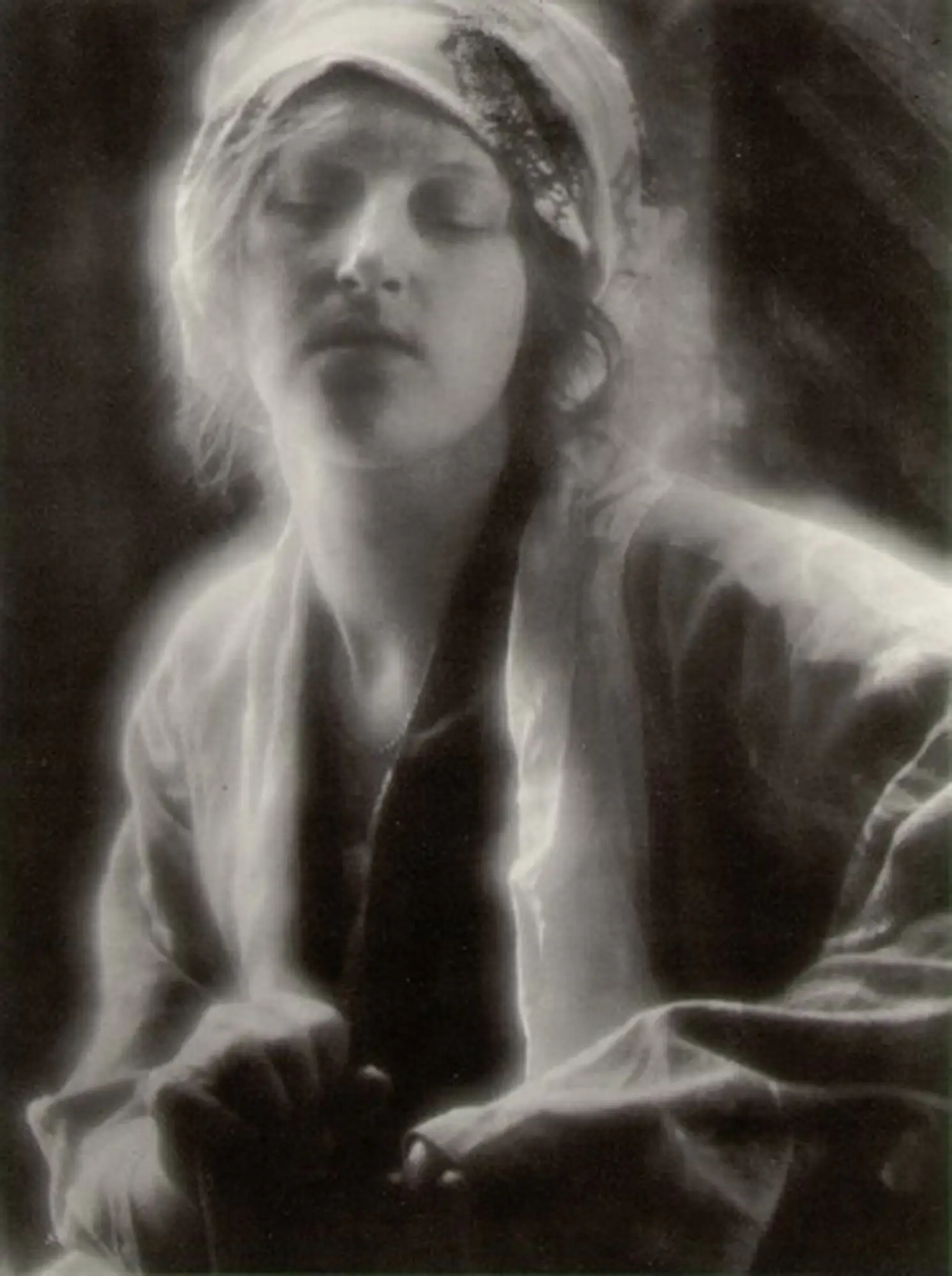
    Dream — Imogen Cunningham

    When? Why?

    Photography didn't have it easy at first. Before its invention, painting was the only way of capturing reality, and painters were naturally afraid of losing their privileged position and ending up painting living rooms. Everyone is a general after the battle, and we now know that's nonsense - but it's an interesting analogy to today's rise of artificial intelligence and the false prophets heralding the extinction of photographers (Photography is dead! Burn the cameras! Welcome our new AI overlords!). I won't poke with the tripod into the wasp's nest, though; that's material for another article.

    Anyway, photographers were initially bullied by the paintbrush people and their art was considered inferior to theirs. Determined to put themselves on a par with their oppressors, they decided to create a visual direction that brought photography closer to painting - pictorialism was born. Or maybe it was a little different, too. Or maybe not. 1885 is far enough away, who remembers, right? The movement is divided into four developmental phases and had its biggest boom by the time of the First World War, after which harsh reality came in and there was no mood for dreamy thingies.

    However, it would be unreasonable to attribute the nascency of this movement solely to painters being pissed off—pictorialism has a distinctive and appealing aesthetic and even today finds many followers without the fear of being stabbed with a paintbrush in broad daylight.

    What is it?

    The use of pictorialism is accompanied by the use of so-called noble printing methods and especially soft-drawing optics. These were often meniscus-like and very simple.

    • A meniscus is a crescent-shaped fibrocartilaginous anatomical structure in the human body, they are present in the knee. In photography, however, it is a simple lens made up of a single piece of glass or at most two cemented elements. Simpler is really just a pinhole camera. You can get a very basic overview for example here.

    Soft-drawing optics—how do you recognize them? To the untrained eye, it might look like an out-of-focus photo fit for the trash bin. But that would be a sad mistake and it's more complicated than that—an out of focus photo is just out of focus, the lines are blurry, the patient is dead. Whereas with soft-focus optics, it's actually a controlled optical defect of spherical and chromatic aberration. The lines remain sharp, but are surrounded by a glowing halation effect creating unmistakable overexposed highlights and a typically "colonnaded" and "dreamy" effect. You won't achieve this result by simple misfocusing and the output will not be pleasing to the eye. 

    • You may come across the terms soft-focus and pictorialist lens. They are actually two names for the same thing, although there is a sort of general consensus that the second one have a stronger "softness" effect. However, it's hard to focus with all of them and takes years of suffering and sacrifice.
    • The use of soft-focus optics was especially popular in the first days of Hollywood. Soft rendering smoothed out wrinkles and made younger beauties. This probably also gave rise to the unfortunate opinion of some intellectually weaker individuals denying use for anything other than portraiture. Don't be led astray—the enchanting character oozes from landscape, still life or nude just as powerfully.

    Types of mechanism?

    There are several ways to adjust the soft-focus (SF) effect. The most fancy one features a separate selector on the lens body (Universal Heliar, TTH Cooke, Aldis, Crown etc.) that is independent of the aperture scale—so you are in control of everything

    A popular method is to control the SF strength via the aperture scale. The more you close the aperture, the weaker the effect. The disadvantage is the impossibility of the tandem "closed aperture + strong SF" or "open aperture + weak SF". Typical examples are Hermagis/SOM Berthiot Eidoscope, Kodak Portrait or Nicola Perscheid.

    Other lenses use the degree of screwing the front or rear element as a selector. Simply put, the more you screw out the lens, the stronger the effect you get. And if you unscrew too much, the whole thing falls out and you will shit yourself, because these things don't exactly come cheap. You'll find this with Wollensak Velostigmats or Dallmeyers, for example (the early versions screwed in the rear member—so the bad thing is that you have to take the whole lens out of the standard when you want to change that. Newer versions have moved this to the front and the latest ones have a separate selector in the lens chassis).

    Probably the least common style is the usage of special rings regulating the diffusion rate, the fancy equivalent of the aperture. The only representative of this obscure method I can think of now is the Rodenstock Imagon or Fujinon SF, where they were snapped onto the front thread like filters or lens hoods. The downside is the need to keep an eye on them - these little buggers are conspired together with lens caps, remote triggers and odd socks for frequent escapes into the unknown.

    There are of course exceptions, for example lacking the SF effect selector as well as the possibility of selecting the aperture. So you have a fixed focus, a fixed aperture and a fixed amount of softness. Now fight! For example the valued Oscar Zwierzina Plasticca or some iterations of Puyo lenses will make your life harder.

    • Some optical designs (pictorialist lenses like the Puyo or Eidoscope in particular were affected) were not corrected for color photography, optical defects and the entire color spectrum. The most painful part was mainly chromatic aberration, for which so-called chemical focus had to be reckoned with. Simply put, the resulting photo appeared out of focus due to ultraviolet light—mainly because the human eye struggles to focus on the blue part of the spectrum—hence the scales on the lens chassis for subsequent correction (Puyo). With modern panchromatic films this problem should not arise, however, fans of orthochromatic films or collodion and other processes sensitive to the blue part of the spectrum should beware.

    How to do it?

    And of course there are wild exceptions of the exceptions stemming from experimental spirit of the human nature or deep pockets. First of all, one can experiment with ordinary lenses - just partially unscrew the front or rear member and create a "fake" soft-focus effect not unlike much more expensive specimens designed for this purpose. Take note however, that not every optical design is inclined to this, and triplets and their derivatives are generally well suited to it.

    • An ideal candidate for testing might be, for example, the notorious Tessar. There are many types, they are everywhere and they are cheap.

    Also, the optical members of the lens (or entire lenses) can be rotated, flipped or removed entirely. Not everywhere you can do this and not everywhere it will have the meaningful effect which one you desired, but why not...

    • Rotating usually reduces the coverage and gives the lens a rather crazy character. Extraction usually takes the front member off and results in a substantial increase in focal length, decrease in lens speed and increase in coverage.
    • Some lenses are designed with these modifications in mind and are purposely built for this (so-called convertible lenses), generally as a portrait/landscape tandem (old petzvals or Spencer Port-Land, from Portrait-Landscape). However, modular solutions, called casket sets, are also popular, where you are adding and removing accessory lenses and changing focal points (de facto predecessors of zoom lenses). So you can cover several lenses with one kit. But more about that another time.

    If, however, you find all this too civilised, you can, like the old masters, put petroleum jelly on the front lens or pull a stocking or curtain over it. Results are not guaranteed, but the fun is 100%. Oh and when you pull down the hosiery from some poor lady under the auspices of a higher artistic principle, I disclaim all responsibility.

    If you've made it this far through today's jumble and still feel pictorialistically unfulfilled, you might find this multi-part article on large format soft-focus optics useful—including examples and illustrations. For individuals who have not yet found the one and only large format true path, this book with tutorials and examples for medium format and 35mm in particular may also be useful. Just be careful, this hole is pretty damn deep—and I warned you. There is peace in my soul.

    Ze své lásky k impresionismu a piktorialismu jsem se vypsal, na závěr vám tedy snad již jen předám svá těžce nabytá životní moudra — Dokonalost je v nedokonalosti! Svět je hranatý a ostrý, alespoň ho měkce foťte! I sny se dají zvěčnit! Sofťák do každé rodiny! Pořádně osolte vodu než dáte vařit těstoviny!

  • Středoformát na krku a Thajsko pod nohama

    Medium format on the neck and Thailand underfoot

    And that means only one thing—throwing out useless things like clothes or food and stuff your gear instead. If you're sane, you'll naturally pack the most basic, lightest and most versatile gear available for a photo shoot.

    But...

    Nope!

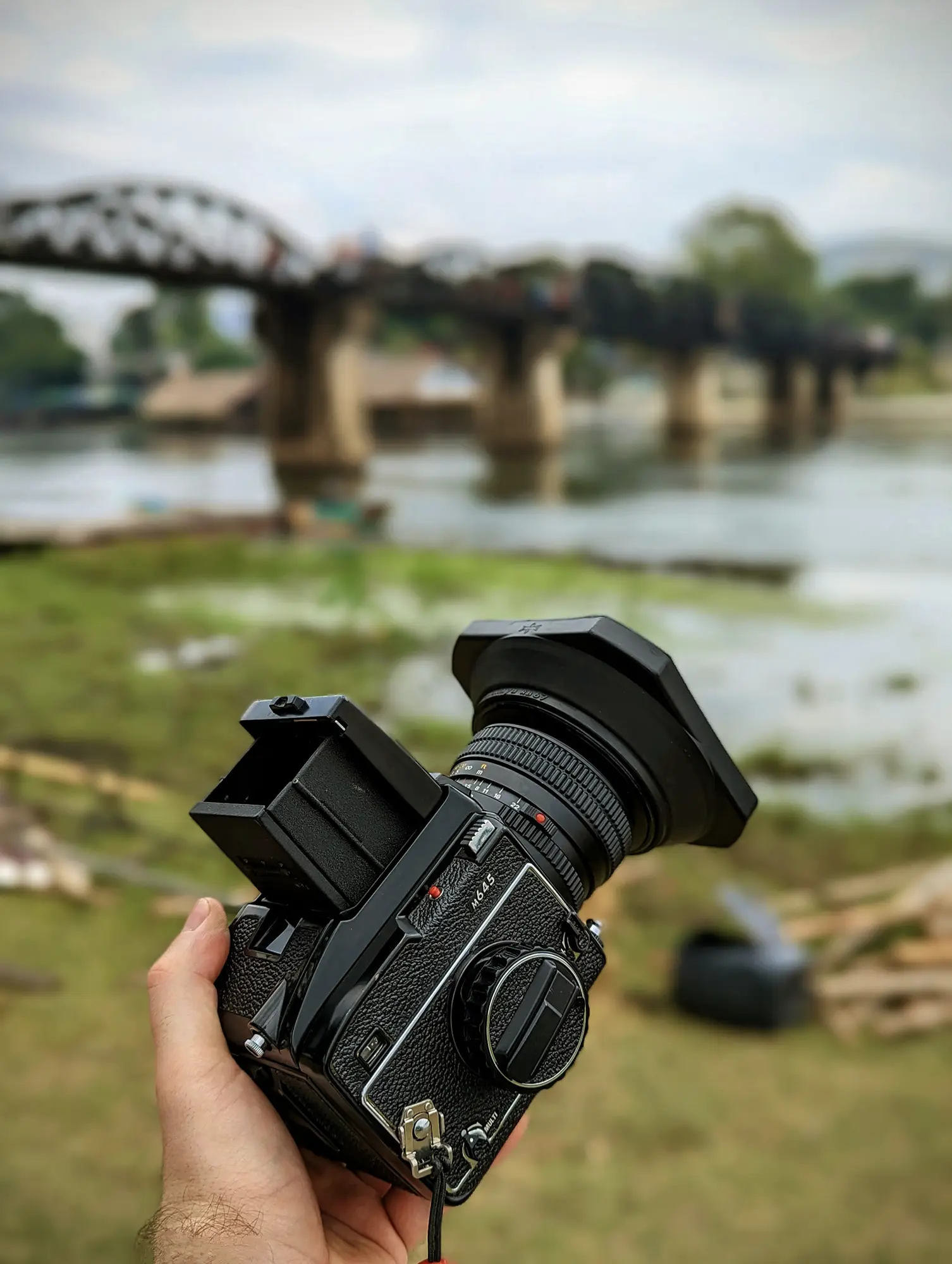
    Since suffering harden character and one of my ancestors was probably a flagellant, I decided many years ago to abandon 35mm film and travel exclusively with the medium format Mamiya M645, a time and habitat-tested indomitable machine. Of course, I would prefer to carry 8x10" large format, but I'm not really going to fuck with that at the airport and then somewhere in the jungle. So my most basic setup for getting through the wilderness consists of:

    • A Mamiya M645 camera with a waist level finder and two lenses (in this case a Sekor C 35mm f3.5 N and a Sekor C 110mm f2.8 N—a proven duo covering all the focal lengths I like). Then a compact and lightweight carbon tripod (Rollei Compact Traveler No.1 ), a bunch of roll films (exclusively black and white), a polarizer and ND1000 filter, an exposure meter (Gossen Profisix) and a few little thingies more—a lenshood, a wire shutter, a spare battery, a cloth, a tripod allen, a plate, a strap and God knows what else and of course some sort of shoulder bag to carry the damn things.

    If you manage to defend the films at the airport from being X-rayed and untangled by nosy staff (and not get a rectal exam while grumbling), you can continue to the real fun. The joys and sorrows of one such trip can be soak up from my excerpt below. Grab your beer and have fun with the suffering of others.

    First grief

    — ความโศกเศร้าประการแรก

    You wander like a slug through the jungle from left to right and around and around, with a bag, another back, a camera, a lens, another lens, a tripod, it's hot enough to die, you're sweating, tigers are circling around, mosquitoes are eating you, vultures are above you, leeches are below you—and you wonder if you're not an idiot.

    Why don't you get yourself a nice, small, lightweight digital, you can't handle it anyway, so why bother. And then you'll see something nice, like a waterfall. You unpack your shit, load the film and after an hour of preparation you'll shoot it and move on.

    And after developing it at home, drying it, scanning it—just fucking with it for half a day—you find out that it worked. Not because you got lucky, of course, but because you're a cool bro. And suddenly you don't want to turn your tripod into a lamp and your camera into a mushroom steamer any more. At least until the next day.

    Second trip

    — การเดินทางหมายเลขสอง

    So far the usual scenario—suffering me, covered with cameras, tripods, junk, going up, down, sun, heat, thousands of stairs somewhere to the jungle.

    But suddenly some news—before the final and worst climb, comparable perhaps only to the ascent to the last metres of K2, a sign warning the faint of heart and will that this is really not a good idea. The fact that the sign is exceptionally written in English adds to its credibility, so it's clear that this is no fun. However, I was assured by my escort that I am neither a cardiac nor a weakling, but just a plain lazy pig, so the attempt failed and we move on.

    And then, after conquering the last bit of the section lined with the bleached bones of the unfortunates who took the wise sign lightly, we're there. Phraya Nakhon opens up before us.

    A series of caves, stone bridges and tunnels leading to a breathtaking and truly gargantuan dome whose monstrosity I won't even attempt to put into words. And above it all, a single source of light, a giant hole lined with jungle on the surface. And we're there just in time—a few minutes later, the sun reaches a position where it illuminates the inside of the dome through the hole, its rays falling directly on the gold-encrusted monastery in the centre.

    What I have to say, it was worth it again. Just a good hole, 9.5/10. I'm saving the last points for the next cave.

    Suffering number three

    — การต่อสู้ครั้งที่สาม

    First snorkeling!

    We set sail for the open sea and the Koh Phi-Phi archipelago—but as the boat moves more from top to bottom and left to right than forward, breakfast soon starts to wonder what the party is like up there, and wants to take a look too. When some of the crew start puking in the trashcan and others ask for life jackets, I start to feel like I should have stayed on the beach and scared the crabs. Anyway, we arrive and off to the coral reefs we go!

    Due to the lack of warning that there may be water on board the boat, I somewhat undignified and unplanned slide into the depths. Naturally and quite unerringly, I also get a single leaking mask and snorkel, so while the others are enjoying the beauty of underwater life, I willingly undergo waterboarding with every attempt to submerge my face and breath, and I sounds like the filming of Deep Throat.

    After half an hour of arousing general merriment among all the beautiful creatures below me, who I couldn't even see despite the salt in my eyes, we set sail again and land on Coconut Island. Not a single coconut anywhere. But I scared some crabs atleast. On land, I'm the boss, crabbies.

    Fourth act

    — บทที่สี่

    Ranger station, deep jungle not long after dawn. As central Europeans used to deer, grass snakes and squirrels, we take the ubiquitous signs warning of tigers and crocodiles with a grain of salt and go to wipe the last white spots off the map. A couple of rangers point their fingers at us, shake their heads and smile, the few tourists who are afraid to get out of the car in the parking lot just shake their heads. Sawat Dý Khrab, you cowards, we'll see you again.

    After about five metres, we both undignifiedly wash out in the first stream we cross, the aura of conquerors sinking, the water in our boots rising, the laughter from the campsite growing. Crabs the size of a hand, spiders the size of a foot (big foot, about number 46) and monkeys about the size of a monkey line our path. Only people are nowhere to be seen. Crocodiles too, thankfully. We're already in the heart of the rainforest when we hear something big up ahead. A really big one. Definitely a lot bigger than a size 46 spider. I tighten the strap on my tactical field hat to keep it from flapping as I escape and bravely climb another metre and a half. When the predator makes a second sound right in the thickets ahead, my courage slowly leaves me and a second later, with the words "fuck it, I'm getting outta here", so does my escort. I realise that I will not be able to beat the tiger with a tripod and I start a tactical retreat.

    But why worry about a female escort? Why would a tiger be chasing a lettuce leaf when there was me, a greasy double cheeseburger who would get a twinge in my side after five yards of running? Easy beast breakfast. Still, we return to camp like wilderness conquerors. No one's laughing anymore. The white spots on the maps remain, the brown in our trousers has been added. Well, bye bye, cowards.

    Fifth time and the end

    — ห้าและสิ้นสุด

    We set out with a rickety kayak for the wide horizons, specifically finding it an irresistible idea to choose an island on the horizon as our destination. What could possibly happen, right. But after the waves start to sort of get bigger, the sphincters tightens and I start humming the soundtrack from Jaws, we turn around and decide to circumnavigate the coast.

    Steep, implacable cliffs, lined with gnarled trees rising out of nothing, rock overhangs and gates, waves crashing against the rocks—and suddenly, amongst it all, a glimpse of a hidden, lonely beach. We land. White-glowing sand, clear water, all enclosed by a crescent of impenetrable jungle. Okay!

    On the way back we pass the Emerald Cave, where there is only one way to go—leave the boat, jump into the depths and swim in absolute darkness (okay, we had a headlamp) for a few hundred meters before we stand on another beach, surrounded by rocks and accessible only from the sea and at low tide. 9.6/10.

    We sail in with the sunset, whose colours we can't believe (which I'll immortalise for you on a black and white film, you're welcome), and it's off to dinner. Christmas Eve. We sit surrounded by the jungle amongst the beautiful 120dB screeching of cicadas in the local "restaurant." We swap the schnitzel for Massaman Curry, the Potato salad for Tom Kha and top it off with Mango Sticky Rice. The power is out, so we finish our meal between the Christmas lights and roll back across the island through the dark wilderness. That was good.